Key Points
- •The gradual or sudden merger of biological and artificial intelligence
- •Brain-computer interfaces (BCIs) as early steps toward integration
- •Could preserve human agency in a world of superintelligent AI
- •Neuralink, Kernel, and others working on neural interface technology
- •Raises profound questions about identity, consciousness, and what it means to be human
The Problem of Obsolescence
As artificial intelligence advances toward and beyond human-level capabilities, a fundamental question arises: what role remains for biological humans in a world of superintelligent machines?
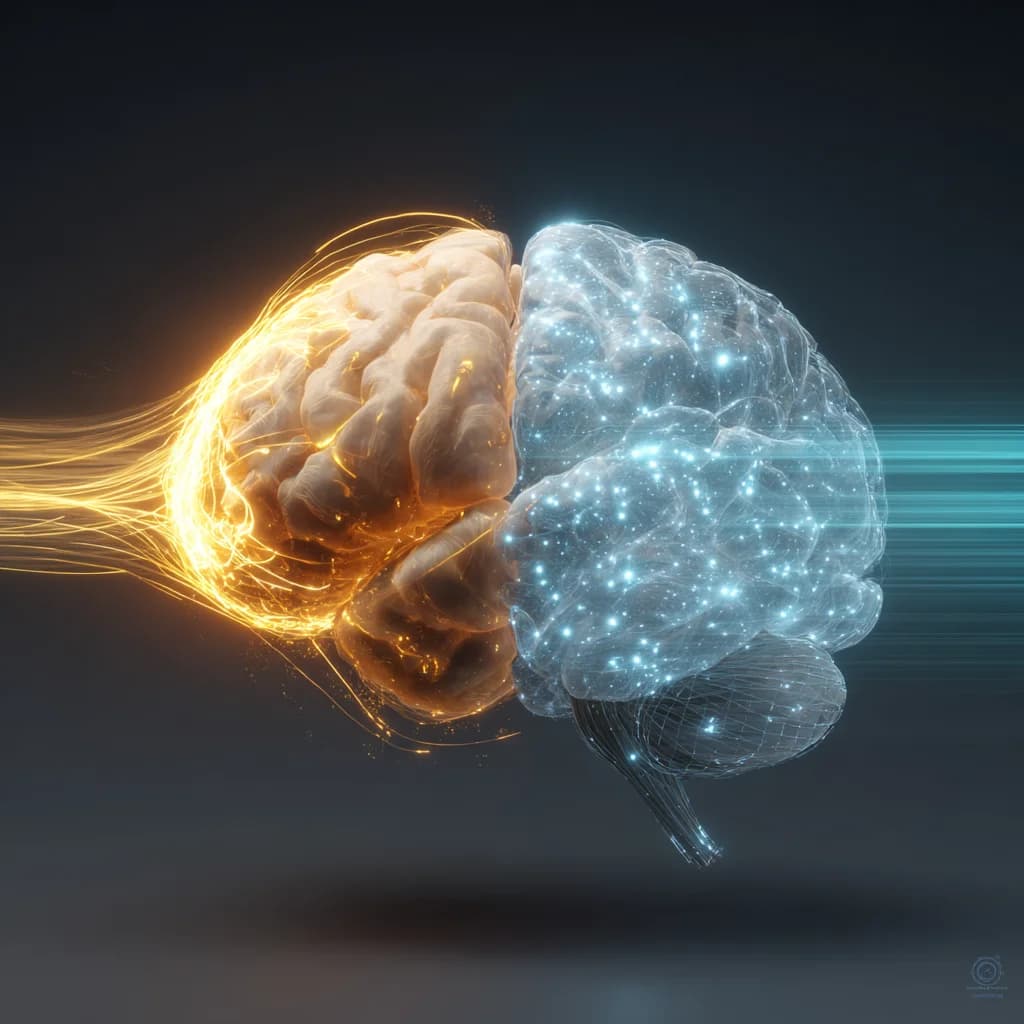
The Merge proposes an answer: rather than competing with AI or being replaced by it, humans integrate with it. By connecting our brains directly to artificial systems, we could expand our cognitive capabilities, access the processing power of machines, and remain full participants in the posthuman era.
From External to Internal
Humanity has always used external tools to extend our capabilities. Writing extended our memory. Calculators extended our mathematical abilities. The internet extended our access to information. Each of these required us to interface with tools through our bodies, our eyes, our fingers, our voices.
The Merge represents a qualitative shift: moving the interface from external to internal, from mediated to direct. Rather than typing a query into a search engine and reading the results, a merged human might simply think the question and know the answer.
Current Brain-Computer Interfaces
The technology underlying the Merge is already in development:
Medical BCIs: Neuralink's PRIME study implants a wireless brain interface in people with paralysis, who use it to control computers by thought alone: browsing, gaming, and communicating. These are assistive devices today, but they are the first working bridges between neurons and software, and each generation raises the bandwidth.
Non-invasive approaches: Companies like Kernel and OpenBCI are developing less invasive neural interfaces using external sensors. While lower bandwidth than implants, these avoid surgical risks.
Neural dust and nanobots: More speculative approaches imagine thousands of tiny sensors distributed throughout the brain, potentially injected rather than surgically implanted.
Degrees of Integration
The Merge might occur along a spectrum:
Augmentation: Brain interfaces that enhance specific capabilities, perfect memory, faster calculation, direct access to information, while leaving the core of human cognition unchanged.
Symbiosis: Deeper integration where an AI serves as a cognitive partner, handling some mental tasks while the biological brain handles others.
Gradual replacement: As neurons age or fail, they might be replaced by artificial equivalents, leading to a gradual transition from biological to synthetic substrate.
Uploading: The most extreme form, complete transfer of the mind to digital substrate, leaving biology behind entirely.
Questions of Identity
The Merge raises profound philosophical questions:
- If you enhance your intelligence a hundredfold, are you still you?
- If your memories are stored in the cloud, where does "you" reside?
- If multiple people share merged access to the same AI, where do the boundaries of self lie?
- At what point does a merged human become something other than human?
They will become practical questions as the technology matures, and individuals, societies, and legal systems will need answers.
Related Concepts
Thinkers Exploring This



Related Articles