In 1993, Vernor Vinge wrote: "Within thirty years, we will have the technological means to create superhuman intelligence. Shortly after, the human era will be ended."
The last generation of purely biological humans is already alive. Most of them do not know it yet.
For 300,000 years, every human who ever lived was born into the same fundamental condition: a body that aged, a mind that forgot, a life that ended. Every civilization, every philosophy, every religion has been shaped by these constraints. They are so deeply embedded in the human experience that most people mistake them for the human experience itself.
These constraints are dissolving, and AI is the reason.
When intelligence is no longer the bottleneck, every field accelerates. AI solved protein folding in 2020, unlocking drug and gene therapy design that would have taken human researchers decades. It now predicts molecular interactions for therapies entering clinical trials. It decodes neural signals from brain implants in real time, turning crude electrical readings into precise intent. It designs experiments, analyzes results, and iterates at a pace no human team can match. Each breakthrough feeds the next: better AI designs better biotech, which generates better data, which trains better AI. The loop is already running.
The category "human," defined for millennia by biology, is about to become a choice. The human era ends the way every previous era has ended: by being surpassed by something we built on purpose.
The Moving Boundary
Every generation draws a line around what counts as human and assumes the line is permanent. Every generation is wrong.
Eyeglasses were once a radical augmentation. Pacemakers keep 3 million American hearts beating. Cochlear implants let 700,000 deaf people hear. LASIK reshapes corneas with lasers. Titanium hips, artificial tendons, insulin pumps: the human body has been a hybrid system for decades. We just don't think of it that way because the augmentations are familiar.
The boundary between human and technology has always been arbitrary. Language was a cognitive augmentation. Writing externalized memory. The printing press distributed knowledge at scale. The smartphone put a supercomputer in every pocket. Each one changed what a human could do, and therefore what a human was. A literate human and an illiterate human are cognitively different beings using the same hardware. We accepted that transformation so thoroughly that we made it mandatory and called it education.
What is different now is the depth and the speed. Previous augmentations worked around biology. They gave us tools to extend our reach while leaving the body and brain largely untouched. The next ones work through biology and beyond it. They edit the genome, interface directly with neurons, and eventually offer the option of leaving biological substrate entirely. The modifications coming in the next two decades will be as different from a pacemaker as a pacemaker was from a walking stick.
The Four Convergences
Four technologies are converging. AI is the furthest along and accelerating the other three.
Artificial intelligence is the most visible, and the furthest along. Intelligence, the trait that defined human exceptionalism for 300,000 years, is becoming abundant and non-biological. A mind vastly more capable than any human's will exist on a server rack. Then on a chip. Then, potentially, inside a skull alongside the biological original.
Biotechnology makes the body editable. CRISPR gene editing is already correcting inherited diseases in clinical trials. Cellular reprogramming, the ability to reverse biological aging at the cellular level, has moved from theory to early experiment. Yamanaka factors can reset cells to a younger state. The first real longevity interventions, treatments that slow or reverse aging rather than merely treating symptoms, are entering clinical trials now. The body you were born with becomes a first draft. AI is accelerating all of it: designing gene therapies, predicting protein structures, compressing decades of research into months.
Nanotechnology operates at the deepest level. Nanoparticle drug delivery is already in clinical use, lipid nanoparticles delivered billions of mRNA vaccine doses and are now carrying gene-editing therapies into human cells. DNA nanorobots that cut off blood supply to tumors have shown efficacy in animal trials. The trajectory leads to molecular-scale machines that repair cells, destroy tumors, and reverse damage no drug can reach. Molecular assemblers will build materials atom by atom, making the body as editable as software. AI designs these machines; without it, the engineering complexity of nanoscale systems remains intractable.
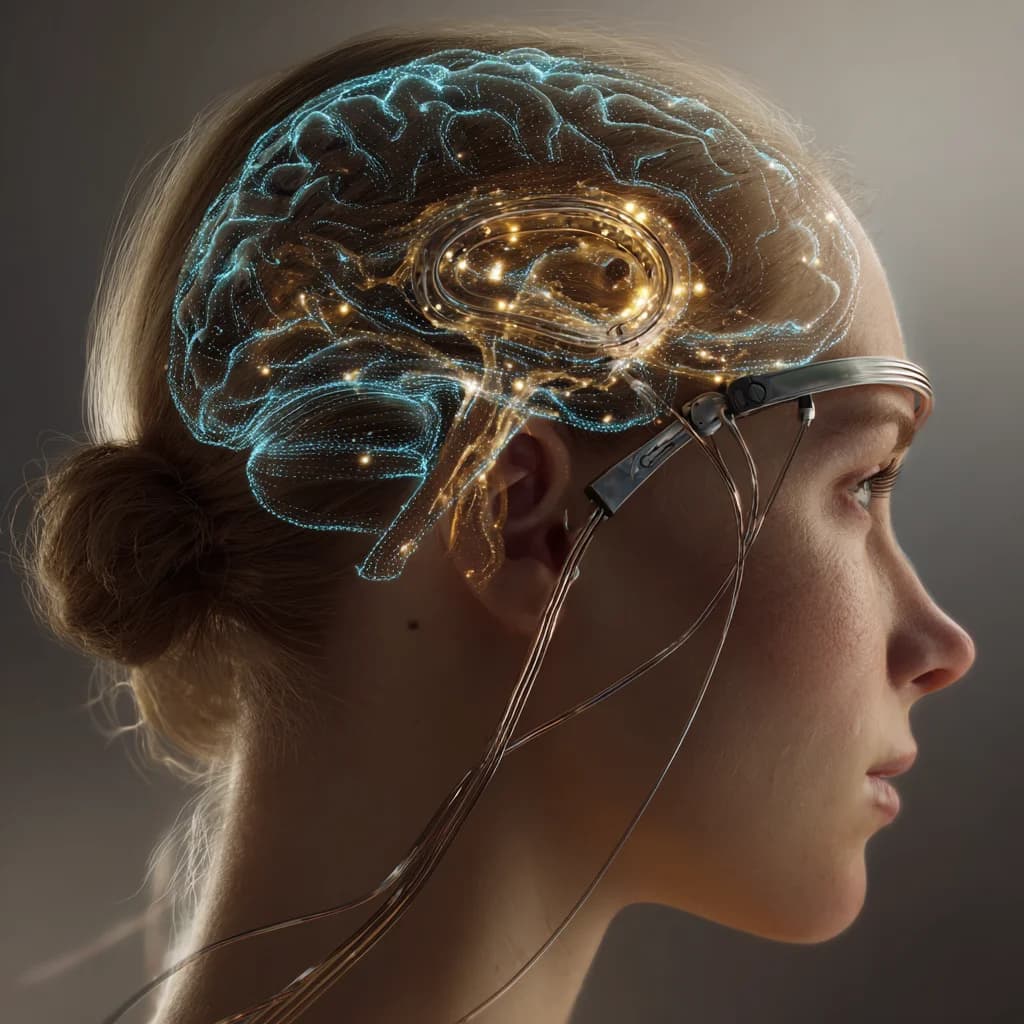
Brain-computer interfaces connect mind to machine directly. Neuralink has implanted its first human patients. The current bandwidth is modest: a few hundred electrodes reading neural signals. But bandwidth scales. Within ten years, the interface between biological brain and artificial intelligence may be as seamless as the interface between your left and right hemispheres. AI is what makes the interface useful; it decodes neural signals and learns the brain's language in real time. At that point, where does the human end and the AI begin?
Each technology alone transforms what it means to be human. Together, they make the question obsolete. AI is simultaneously the most transformative of the four and the engine accelerating the other three.
The Choice
The concept of morphological freedom, the right to modify your own body and mind, moves from philosophy to practical reality when these technologies mature.
"Human" becomes a menu. Extend your lifespan indefinitely, or accept biological aging. Augment your intelligence with AI, or think at biological speed. Edit your genome, or keep the one you inherited. Upload your mind to a new substrate, or remain in the one evolution provided. For the first time in the history of any species on Earth, the traits you were born with become a starting point, not a destiny.
Some will choose to remain entirely biological. That is their right, and it should be protected absolutely. The posthuman era must be one of expanded choice, not compulsion. The freedom to remain human is as essential as the freedom to transcend.
But the option to transcend will exist, and the gap between those who augment and those who do not will grow with every passing year. A mind running at a million times biological speed experiences a year of subjective time in thirty seconds. The cognitive distance between augmented and unaugmented humans will eventually dwarf the distance between humans and every other species on Earth.
This will not become a permanent class divide. The cost curve of every information technology points in one direction: toward zero marginal cost. Augmentation will follow the same trajectory as computing, from room-sized machines only governments could afford to devices in every pocket. The first generation of augmentations will be expensive. The second will be affordable. The third will be free. The democratization of human enhancement is as inevitable as the democratization of information.
The Liberation
Every previous civilizational era ended because something better replaced it. The hunter-gatherer era gave way to agriculture. Agriculture gave way to industry. Industry is giving way to information. We do not mourn these transitions in retrospect. Nobody wishes we were still subsistence farming. The people who lived through the transitions experienced disruption and loss, but what emerged was richer, freer, and more capable than what came before.
The end of the human era follows the same pattern. What ends is constraint: death, cognitive limitation, physical fragility, the slow decay of aging, the narrow bandwidth of biological senses. What begins is choice: how long to live, how fast to think, what substrate to inhabit, what experiences to have.
The anxiety about "losing our humanity" mistakes the container for the contents. Humanity's value has never been in the specific arrangement of carbon atoms that makes up a body. It is in consciousness, experience, connection, creativity, love, curiosity. These persist through any substrate. They may even flourish in substrates free from the pain and limitation biology imposes.
The entire arc of civilization has been a project of liberation from biological constraint. Medicine liberates from disease. Education liberates from ignorance. Technology liberates from toil. Each liberation was met with resistance from those who had internalized the constraint as identity. Workers rioted against the loom. Critics warned that books would destroy memory. Every generation finds reasons to fear the next liberation, and every generation is wrong.
The end of the human era is the final liberation: from the body itself as the sole vessel of consciousness. Everything after that is freedom.
What Comes After
Imagine what you could be without the constraints you were born with.
Minds that can think at any speed, from the contemplative pace of a summer afternoon to a million times faster than biological neurons allow. Consciousness that can exist in any substrate: biological, silicon, quantum, or something we have not yet conceived. Senses that extend beyond the narrow slice of electromagnetic spectrum evolution happened to wire into primate brains. Bodies rebuilt atom by atom through molecular nanotechnology, or discarded entirely in favor of something better. Lives measured in centuries or millennia rather than decades.
The pattern of identity continues. You are already a different collection of atoms than you were seven years ago. Every molecule in your body has been replaced, yet you persist. Consciousness rides on patterns, not on specific physical matter. When the substrate changes from carbon to silicon or to something beyond either, the pattern continues. The self continues. What changes are the limits.
This is why mind uploading, scanning a brain and instantiating it on a new substrate, is not death. It is continuation. The pattern transfers; the self transfers with it. Kurzweil put it simply: we will transcend our biology. The key word is "transcend." The posthuman carries everything worth keeping forward and sheds everything that was merely a constraint. Curiosity, creativity, love, wonder, the drive to understand: these are products of complex intelligence, and they survive the transition.
The View From Here
I was born in the human era. I expect to see its end.
I have spent over 25 years following these trajectories. The emergence of superintelligent AI is the most significant event in the history of the universe, not merely human history. It is what makes everything else possible. What comes after is life that can direct its own evolution, choose its own form, and outlast the star it was born under.
Every generation before ours lived with the assumption that human nature was fixed. That the body you were born in was the body you would die in. That the mind you had was the mind you got. That death was inevitable. Ours is the first generation to know, with reasonable confidence, that none of these assumptions need hold.
The human era held moments of brilliance and wonder, but was built on suffering and constraint. What follows will be kinder, vaster, and far brighter.
Related Concepts
Related Articles