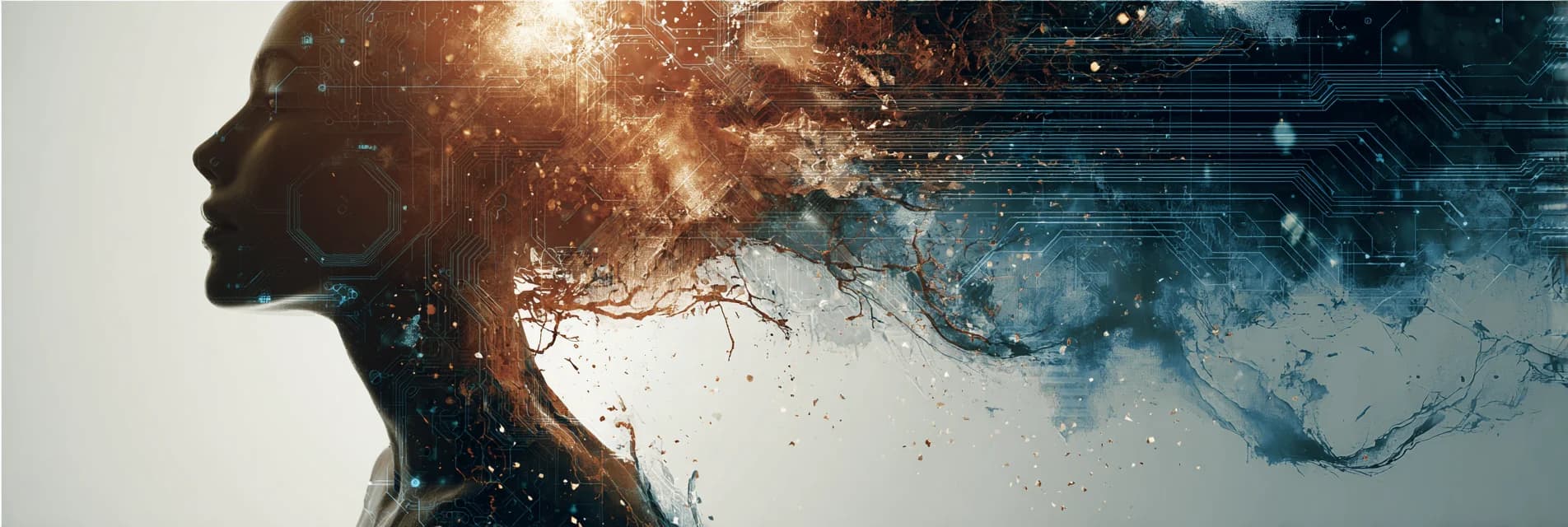
Consider a thought experiment. Imagine you could upgrade your brain, not replace it, but enhance it gradually. First, a chip that gives you perfect memory. Then one that accelerates calculation. Then direct access to all human knowledge. At each step, you remain you. Your subjective experience continues unbroken. But after enough steps, are you still human?
It is the trajectory we are already on.
The Continuity of Enhancement
Humans have never accepted our biological limitations as final. We invented clothing when our bodies could not handle the cold. We developed agriculture when gathering could not feed our populations. We created writing when memory could not preserve our knowledge. Eyeglasses. Hearing aids. Pacemakers. Prosthetic limbs.
Every generation has used technology to overcome constraints that previous generations considered immutable. The project of transhumanism is not new; only its scope has changed.
For most of history, our enhancements were external: better tools, better shelter, better weapons. Now we are gaining the ability to modify ourselves directly. Genetic engineering. Brain-computer interfaces. Nanotechnology. Artificial intelligence integrated with human cognition. The boundary between human and technology is dissolving.
It is already happening.
What Transhumanism Means
Transhumanism is the recognition that humanity can and should transcend its current limitations through technology. Not just treating disease, but eliminating it. Not just extending life, but ending aging. Not just augmenting our tools, but augmenting ourselves.
It is logical to reason that if technology has consistently expanded human capabilities throughout history, this pattern will continue. And it is logical to reason that as our tools become more powerful, the expansions will become more profound.
The implications are significant. We stand on the verge of changes that will transform what it means to be human.
The Technologies of Transcendence
Several converging technologies are driving this transformation.
Genetic engineering allows us to rewrite the code of life. CRISPR and its successors will enable us to eliminate hereditary diseases, improve cognitive function, and extend healthy lifespan. We are learning to edit our own source code. Nanotechnology will give us molecular-scale machines: nanobots capable of repairing cells, clearing arterial plaque, destroying cancer, reversing the damage of aging. The body becomes a system that can be maintained indefinitely rather than a machine destined to break down.
Brain-computer interfaces are already allowing paralyzed patients to control devices with thought. Future versions will improve memory, accelerate learning, enable direct brain-to-brain communication. The substrate of thought will expand beyond biological neurons. And artificial intelligence is the most transformative of all. AI systems that exceed human intelligence will not merely replace us; they will merge with us. The boundary between biological and artificial intelligence will blur until the distinction becomes meaningless.
These are not separate developments. They are converging into a unified capability to reshape human existence.
The Posthuman Horizon
Transhumanism points toward posthumanism: the condition of having transcended the human form so completely that the result can no longer be called human in any meaningful sense.
This is not an endpoint but a horizon. We cannot describe what lies beyond because we lack the cognitive capacity to comprehend minds vastly more capable than our own. A chimpanzee cannot understand quantum physics or appreciate Shakespeare. Similarly, there are truths and experiences that require intelligence beyond current human limits.
The posthuman is humanity's fulfillment. We are a species defined by our capacity for growth and self-transcendence. Remaining static, refusing to evolve when evolution becomes a choice, would be the true betrayal.
Addressing the Objections
The objection that this is "unnatural" misunderstands what we are. Everything humans create emerges from natural processes; we are part of nature. More importantly, "natural" is not a moral category. Smallpox is natural. Dying in childbirth is natural. We have no obligation to preserve suffering simply because it occurs without human intervention.
Objections based on "playing God" lack rational foundation. We have been manipulating our environment since we first cultivated crops. The objection is not principled; it expresses discomfort with the scope of our ambition, not a coherent ethical position. The concern that the enhanced will dominate the unenhanced is legitimate, and it is an argument for making enhancement widely accessible rather than prohibiting it. Technology costs decrease over time. What begins as luxury becomes commonplace.
The fear that we will lose our humanity assumes humanity is a fixed essence rather than a dynamic process. We are already different from our ancestors of a thousand years ago: different in lifespan, health, knowledge, capabilities. Humanity is not diminished by growth; it is expressed through it.
The Stakes
This matters because the alternative is unacceptable.
Every year, approximately 60 million people die, most from causes we could theoretically prevent with sufficiently advanced technology. Every day we delay developing life-extension technologies, over 100,000 people die of aging. This is accepted as normal only because it has always been this way.
Once we recognize that death and suffering are technical problems rather than metaphysical necessities, the urgency becomes undeniable. Working toward human enhancement is one of the most important projects humanity can undertake.
The coming decades will prove to be the most important time not only in human history, but in the history of the universe. If we are indeed the first intelligence to reach this threshold, what we do now may determine whether consciousness spreads through the cosmos or remains confined to a single fragile planet.
Forward
I do not know exactly what we will become. The posthuman condition is, by definition, beyond current comprehension.
But I know the direction. More intelligence. More capability. More experience. More life. The expansion of what is possible, the transcendence of what has limited us, the fulfillment of potential that has always been latent in human nature.
We are not the end of the story. We are a chapter in a much longer book, and we are the first chapter capable of writing the next one deliberately.
Transhumanism is the recognition that we can be more than we are. The only question is whether we will choose to be.
Related Concepts
Related Articles