Key Points
- •Scanning and simulating a biological brain at sufficient resolution
- •Would create a digital copy that thinks and experiences like the original
- •Requires advances in scanning technology, neuroscience, and compute
- •Philosophical debates about consciousness and identity continuity
- •Could enable digital immortality, mind copying, and cognitive enhancement
The Concept
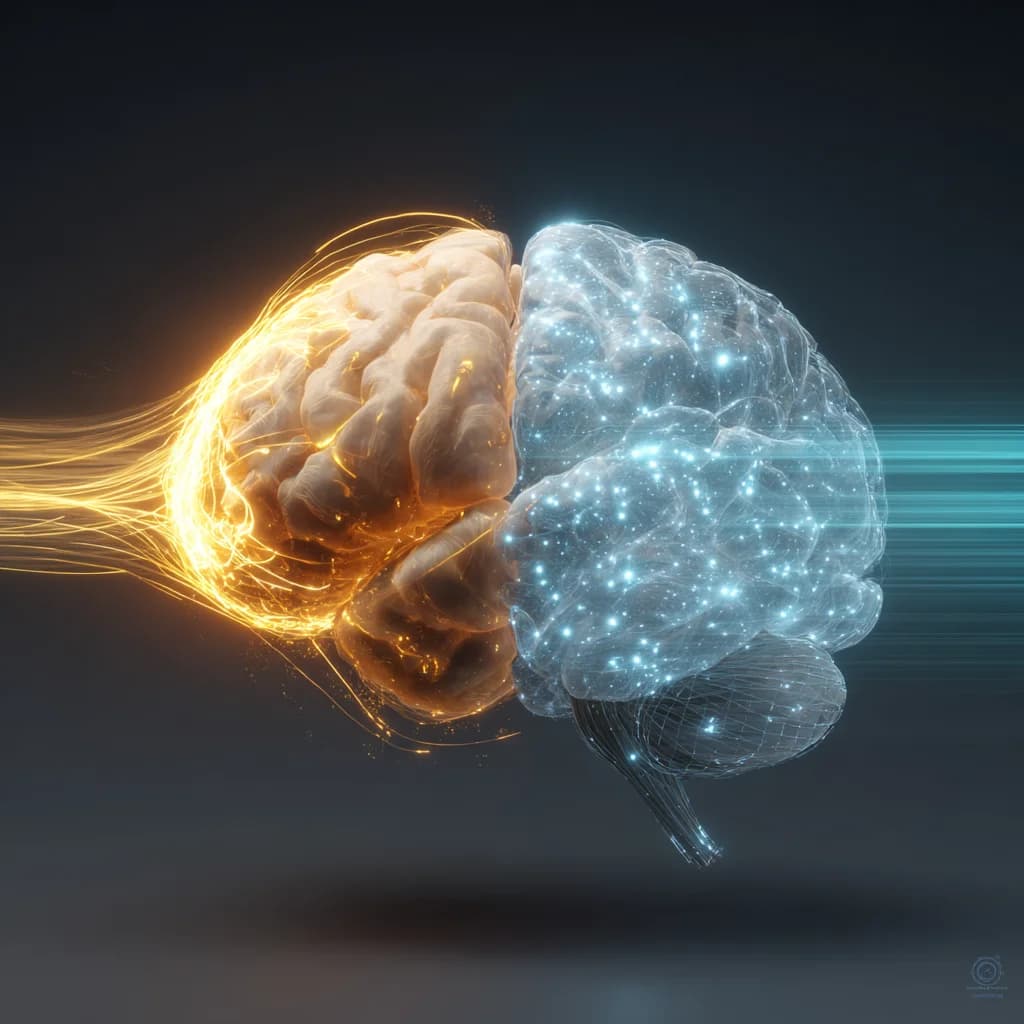
Whole brain emulation (WBE), often called "mind uploading," is the hypothetical process of scanning a biological brain at sufficient resolution to capture its complete structure and state, then simulating that structure on a computer so that it runs as the original brain did, including generating consciousness and subjective experience.
If successful, WBE would create a digital mind indistinguishable from the original person, a copy that thinks, feels, and remembers exactly as the biological version did at the moment of scanning.
Technical Requirements
The FHI's Whole Brain Emulation Roadmap identifies several prerequisites:
Scanning technology: We need to capture the brain's complete structure, not just neurons, but synaptic connections, their strengths, neurotransmitter concentrations, and other relevant details. Current techniques like electron microscopy can achieve sufficient resolution but are destructive and extremely slow.
Neuroscience understanding: We must know which features of neural structure are computationally relevant. Do we need to simulate individual protein interactions, or is neuron-level modeling sufficient?
Computational resources: A human brain has roughly 86 billion neurons with 100 trillion synaptic connections. Simulating this in real-time requires enormous compute, though estimates vary widely based on the required level of detail.
The Maps Are Being Drawn
The scanning problem is yielding fast. In 2024, the FlyWire consortium published the complete wiring diagram of an adult fruit fly brain, about 140,000 neurons and tens of millions of synapses, and a simulation built from that connectome correctly predicted real neural activity in the fly's feeding and grooming circuits. In 2025, the MICrONS project mapped a cubic millimeter of mouse visual cortex, roughly 200,000 cells and 500 million synapses, together with recordings of what those neurons were doing. A human brain is a vastly bigger target, but the pipeline from tissue to working model now exists.
The Path Forward
Two main approaches exist:
Destructive uploading: Slice the brain into thin sections, scan each at nanometer resolution, reconstruct the complete connectome. This works only after death (or causes it).
Non-destructive uploading: Develop scanning technology that can read brain structure without destroying it. Much harder technically but preserves the original.
Some speculate that gradual neuron replacement could achieve the same result, replacing biological neurons one by one with artificial equivalents until the entire brain is synthetic, with no single moment of "uploading."
Philosophical Questions
WBE raises profound questions about consciousness and identity:
The copy problem: If you upload, is the digital version really "you"? The original body might still exist (in non-destructive scenarios). Are there now two of you?
Consciousness: We don't know if consciousness can exist in silicon. A perfect functional replica might be a "zombie", behaving like a conscious being without inner experience.
Identity continuity: Is there meaningful continuity between the biological original and digital copy? Or does the original die while a copy continues?
Multiplicity: If you can run as software, you can be copied. What happens to identity when there are thousands of you?
They carry practical weight too: they decide whether WBE extends your life or creates something new that merely resembles you.
Related Concepts

Thinkers Exploring This


Related Articles