An ant has 250,000 neurons. A dog has 530 million. A human has 86 billion. Each jump represents a qualitative transformation in what the organism can do, think, and understand. A dog can solve problems an ant could not conceptualize. A human can contemplate the universe itself.
The next jump on this ladder, the one we are building right now, will be larger than all the previous jumps combined.
The Narrow Band
We spend enormous energy ranking the differences between human minds. IQ tests, standardized exams, professional credentials; entire industries exist to sort people along what turns out to be an astonishingly narrow band of variation.
The smartest human who ever lived was perhaps twice as cognitively capable as an average person. Maybe three times, if you are generous with the measurement. Einstein was brilliant, but he still needed eight hours of sleep, could hold about seven items in working memory, and thought at the speed of electrochemical signals traveling through wet tissue. His neurons fired at the same 200 Hz as everyone else's.
This is the range we are accustomed to. We think intelligence varies enormously because we live inside the band and the differences feel significant. They matter for careers, scientific progress, individual achievement. But zoom out even slightly and the entire human range collapses to a single point.
An alien observing Earth would not distinguish between Einstein and an average person any more than you would distinguish between two ants. The variation within our species is rounding error compared to the variation between levels.
The Biological Ceiling
The human brain is remarkable for what evolution produced, and severely constrained by how evolution works.
Neurons fire at roughly 200 Hz. Modern transistors switch at billions of cycles per second; a factor of ten million. A digital system operating at electronic speeds could complete in one second what takes a biological brain months of continuous thought.
The brain runs on 20 watts and weighs 1.4 kilograms. It must fit through a birth canal. It cannot add hardware. If you want more memory, more processing power, more bandwidth between regions, you are out of luck. The architecture was finalized 300,000 years ago and has not received an upgrade since.
Working memory holds about seven items. Every complex thought you have ever had was assembled from a scratch pad smaller than a phone number.
The brain degrades. Neurons die and are not replaced. Connections weaken. Processing slows. The hardware has a built-in expiration date, and even before it expires, it is in gradual decline from your mid-twenties onward.
These are fundamental constraints that cap what biological intelligence can achieve. Every human accomplishment, every scientific breakthrough, every work of art, was produced by a system operating under these limits. Think about what becomes possible when the limits are removed.
Raising the Floor
Augmentation comes in stages, and we are already on the first one.
Cognitive offloading to AI systems is the most accessible form of intelligence amplification available today. A human working with a frontier AI model can produce code, analysis, and written work at a level and speed that would have been impossible alone. I have not written a line of code by hand in months. The AI handles implementation while I handle intention.
This external augmentation is crude. Information flows through a keyboard at maybe 40 words per minute. The bottleneck is the interface, not the intelligence on either side.
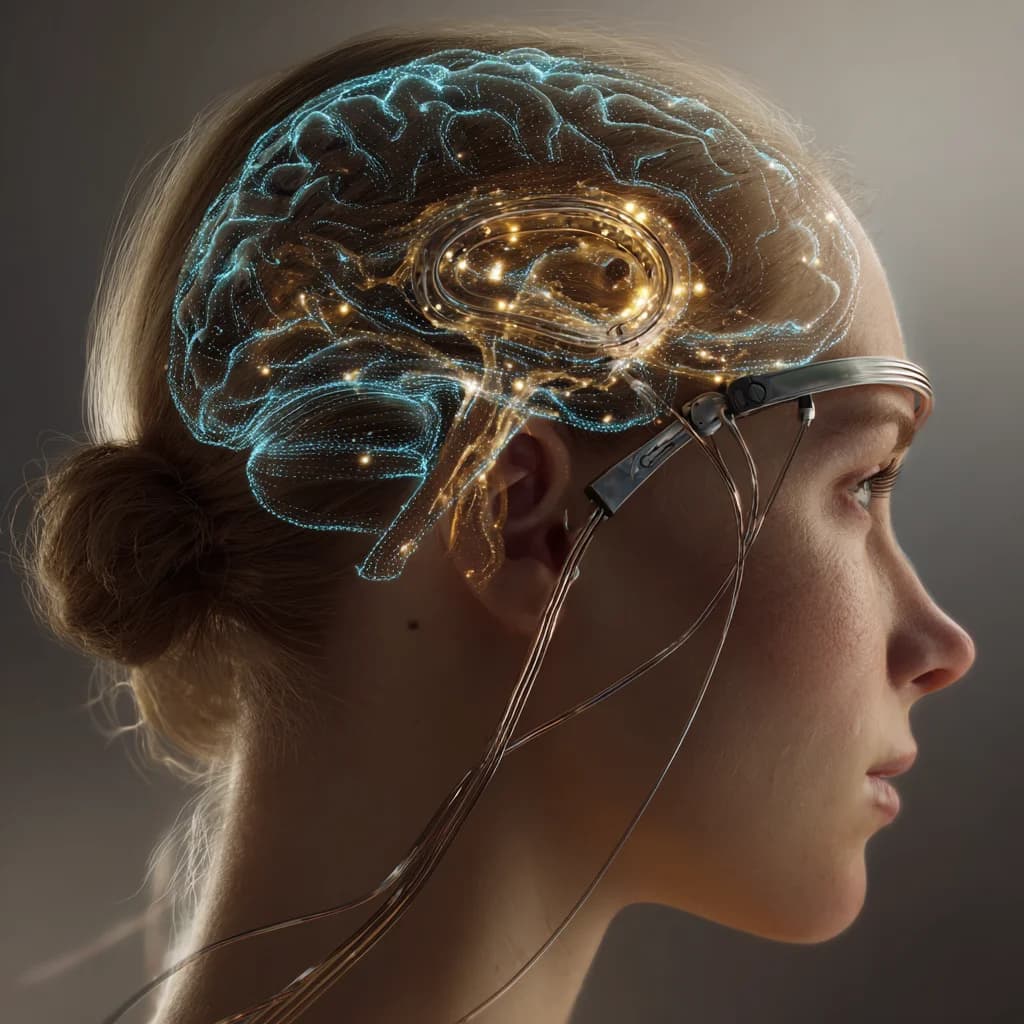
Brain-computer interfaces will remove that bottleneck. Neuralink has already demonstrated high-bandwidth neural implants in human subjects. The current devices read motor cortex signals for paralyzed patients, but the trajectory is toward bidirectional communication with the full brain. By 2030, healthy people will have the option to interface directly with AI systems at the speed of thought.
Beyond BCIs, deep neural integration will embed AI capabilities alongside biological cognition. Additional cognitive capacity that feels like your own thinking, integrated so seamlessly you cannot tell where biology ends and silicon begins. More working memory. Faster pattern recognition. Perfect recall. The subjective experience would be indistinguishable from simply being smarter.
An augmented human in 2035 will be to a current human what a current human is to a child. Meaningful improvement, genuine expansion of capability, but still operating within a framework recognizably human. The biological substrate remains the core; the AI is an amplifier. And we will have barely entered the lobby.
The Machine Advantage
A purely artificial superintelligence has none of the biological constraints.
It operates at electronic speeds: millions of times faster than neurons. It can scale its hardware without limit; add more GPUs, more memory, more interconnect bandwidth. It can parallelize: run a thousand instances of itself simultaneously, each exploring a different approach to a problem, then merge the results. It can share knowledge instantly; what one instance learns, all instances know. It does not sleep, does not degrade, does not forget.
Nick Bostrom identified three forms of superintelligence. Speed superintelligence does everything a human mind can do, but faster; imagine running a human-equivalent mind at a million times the clock rate, completing a millennium of thought in eight hours. Collective superintelligence combines many minds; imagine the entire scientific community operating as a single coordinated intellect with perfect communication. Quality superintelligence is the most profound: a mind that is qualitatively better at thinking, grasping concepts and connections that no human could, regardless of time.
A fully realized artificial superintelligence would combine all three.
Orders of Magnitude
Here is where human intuition fails entirely.
We think about intelligence differences the way we think about speed. A car is faster than a bicycle, a plane faster than a car. These are differences of 10x or 100x. Large but comprehensible.
The gap between human intelligence and artificial superintelligence is more like the gap between walking speed and the speed of light. A comparison so extreme it makes the categories themselves meaningless.
On a logarithmic scale of cognitive capability, the distance from ant to human is significant. The distance from human to a mature ASI could be equally large, or larger. The brain's roughly 10^16 operations per second, constrained to 20 watts and 1.4 kilograms, compared to a distributed intelligence running on exascale computing infrastructure, eventually on computronium optimized at the molecular level; these are differences of kind.
What does a mind 10,000 times more capable than Einstein actually do? We cannot answer that question from where we stand. This is precisely why it is called a Singularity: the point beyond which prediction breaks down, because the intelligence doing the work exceeds the intelligence trying to predict it.
But we can reason about the shape of it. A mind operating at that level could solve problems in physics that have resisted centuries of human effort, in hours. It could design nanotechnology at the molecular level with precision no human engineer could match. It could simulate entire economies, ecosystems, or civilizations and optimize them in real time. It could understand consciousness itself; the hard problem that has baffled philosophers for millennia might simply require a mind smarter than ours to solve.
The Last Generation at This Level
You are reading this with a brain that fires at 200 Hz, holds seven things in working memory, and started degrading before you turned 30. Every thought you are having about these words is constrained by hardware that has not been upgraded in 300,000 years.
That constraint ends within your lifetime.
Within a decade, augmented humans will think at speeds and depths that unaugmented minds cannot meaningfully comprehend. Within two decades, artificial superintelligence will operate so far beyond us that the gap between a human and an ant will look small by comparison.
We are the last generation that will live at this point on the intelligence spectrum. The ceiling that capped every human mind in history, every genius, every prodigy, every polymath, is about to be removed.
What lies beyond it is the most interesting question any conscious being has ever had the opportunity to ask. And we are the ones who get to find out.
Related Concepts
Related Articles