
For millennia, the human brain has been a black box. We could observe its outputs through behavior and speech, but we could not read its internal states directly. We could influence it through drugs and surgery, but we could not write to it with precision.
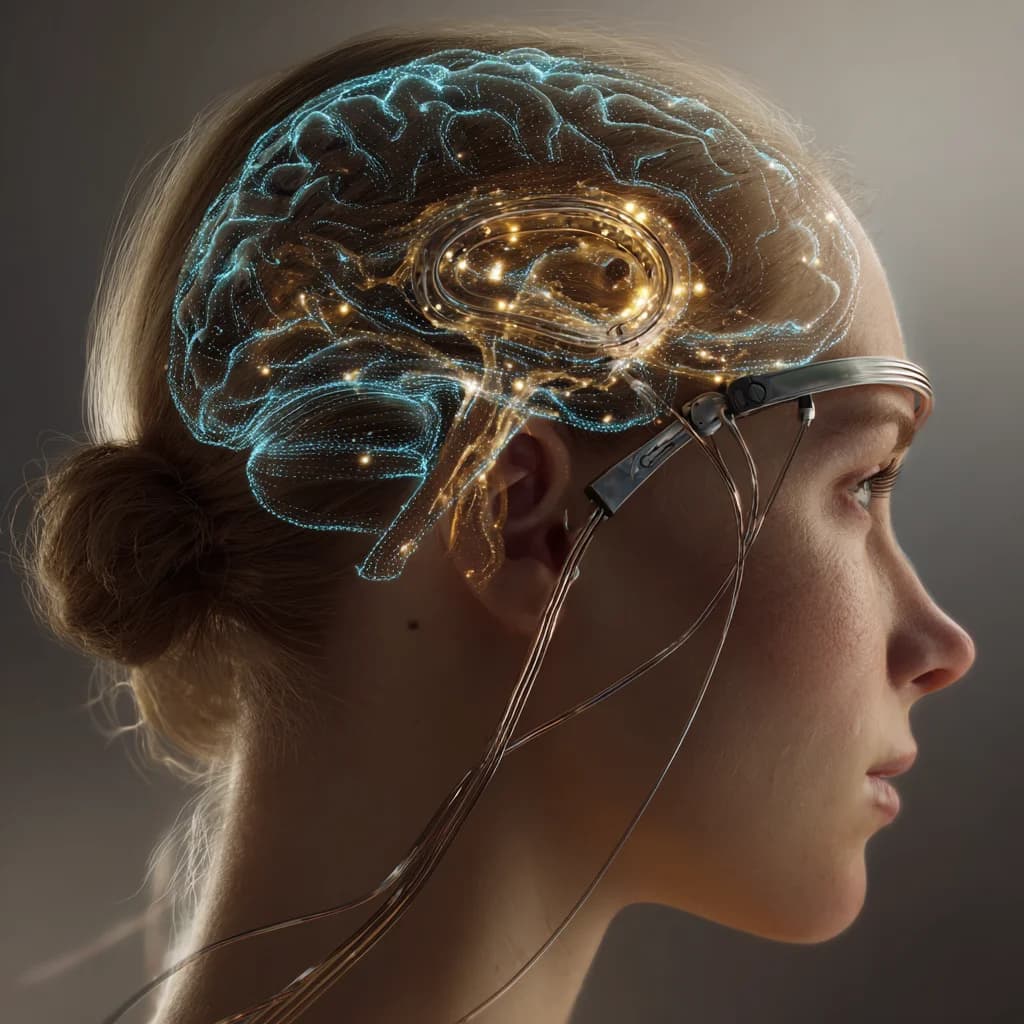
That era is ending. Brain-computer interfaces are opening bidirectional communication channels between neurons and silicon. For the first time, we can read from and write to the brain with increasing resolution and bandwidth.
This is the bridge technology. Not the end state, but the critical transition that makes everything else possible.
The Current State
Brain-computer interfaces have existed for decades, but recent progress has been extraordinary.
Cochlear implants have restored hearing to hundreds of thousands of people by directly stimulating auditory nerves. Retinal implants are providing rudimentary vision to the blind. Deep brain stimulators treat Parkinson's disease, essential tremor, and treatment-resistant depression by modulating neural activity in specific brain regions.
These are medical devices, designed to restore lost function. They demonstrate that the brain can integrate with electronic systems and that direct neural interfaces are not merely theoretical.
More recent developments push toward enhancement rather than restoration. Companies like Neuralink have developed high-density electrode arrays that can record from thousands of neurons simultaneously. These systems are approaching the bandwidth necessary for meaningful cognitive augmentation.
The trajectory is clear: higher density, smaller form factors, wireless operation, longer-lasting implants. Each generation brings us closer to seamless brain-silicon integration.
Why This Matters
The human brain operates at roughly 200 Hz, with neurons firing at a rate millions of times slower than modern transistors. Our working memory can hold perhaps seven items. Our attention is serial; we can focus on one complex task at a time. Our bandwidth for information input and output is severely constrained: reading at hundreds of words per minute, speaking at roughly 150.
These are fundamental bottlenecks. No amount of training or education can overcome the hardware limitations of biological neurons.
Brain-computer interfaces offer a path around these constraints. Not by replacing the brain, but by augmenting it: adding memory capacity through external storage, increasing processing speed through computational offloading, expanding bandwidth through direct neural communication.
Consider what becomes possible. Instantaneous access to any information, not through search but through direct knowledge retrieval. Silent communication between minds, bypassing the lossy compression of language. Computational extensions that handle calculation, simulation, and analysis while the biological brain focuses on intention and meaning.
It is engineering.
The Path to Enhancement
The first generation of enhancement BCIs will be conservative: memory aids, attention enhancement, direct interfaces to computing devices. These will seem like modest improvements, comparable to the smartphone but with lower latency and higher bandwidth.
The second generation will integrate more deeply. Computational modules will handle tasks the biological brain does poorly: mathematical reasoning, perfect recall, rapid pattern matching across large datasets. The biological brain will provide intention, emotion, creativity, and judgment while artificial components provide precision and capacity.
The third generation will blur the boundary between biological and artificial cognition. Neural tissue and electronic circuits will co-evolve, each adapting to the other. At some point, the distinction between thinking with your brain and thinking with your implant will become meaningless.
This progression mirrors what is already happening with external technology. We already think with our smartphones, offloading memory and calculation to devices in our pockets. BCIs simply remove the interface friction.
The Merger Path
Brain-computer interfaces are often discussed separately from artificial intelligence, but they are deeply connected. BCIs provide the conduit through which human and machine intelligence will merge.
Without BCIs, AI remains external. We interact with it through screens and keyboards and voice. The communication channel is narrow, and the integration is shallow. AI assists us, but we remain separate.
With sufficiently advanced BCIs, the boundary dissolves. AI becomes an extension of cognition rather than an external tool. The distinction between what I know and what my AI system knows becomes meaningless when both are accessible with the same mental effort.
This is not replacement; it is integration. The biological brain provides the substrate of conscious experience, emotional depth, and embodied understanding. The AI components provide unbounded memory, perfect calculation, and access to the full corpus of human knowledge.
Together, the hybrid system exceeds the capabilities of either component alone.
Objections and Responses
The objection that this is "unnatural" does not hold up. Humans have augmented themselves with technology since the first stone tools. Eyeglasses, hearing aids, and pacemakers are already commonplace. BCIs extend this trajectory rather than departing from it.
Will it create inequality? Yes, initially. New technologies are always expensive before they become cheap. The correct response is to accelerate development and deployment, not to prevent progress. Equality through universal access is better than equality through universal deprivation. Hacking and security risks are serious concerns that require serious engineering, but we do not refuse to build airplanes because they might crash; we build better safety systems. The same approach applies to neural interfaces.
We do not need to understand consciousness to build interfaces to it. We do not understand aerodynamics at the deepest level either, but we fly. Engineering often outpaces theoretical understanding. And yes, BCIs could be used for control and surveillance. Any powerful technology can be misused. But they could also enable unprecedented privacy through encrypted thought. The outcome depends on how we deploy the technology, not on the technology itself.
Personal Perspective
I will have a brain-computer interface by 2035. Not because I have a medical condition that requires it, but because the cognitive enhancement will be compelling.
The transition will be gradual. First, a simple implant for memory augmentation. Then, expanded capability for direct computational access. Eventually, deep integration with AI systems that extends my cognitive capacity by orders of magnitude.
It is the logical continuation of a trend that began when humans first extended their capabilities with tools. The brain-computer interface is simply the next tool, one that operates at the level of thought itself.
Some will choose not to participate. That is their right. But as BCIs become more capable, the gap between augmented and unaugmented cognition will widen. At some point, choosing to remain purely biological will be choosing a fundamentally different existence, like choosing to remain illiterate in a literate society.
I choose enhancement. I choose the bridge.
Related Concepts


Related Articles