Key Points
- •Technology enabling direct neural connection to computers
- •Current applications: treating paralysis, depression, Parkinson's
- •Future potential: cognitive enhancement, memory augmentation, telepathy
- •Key players: Neuralink, Synchron, Blackrock Neurotech
- •Challenges: invasiveness, bandwidth, longevity, safety
Bridging Brain and Machine
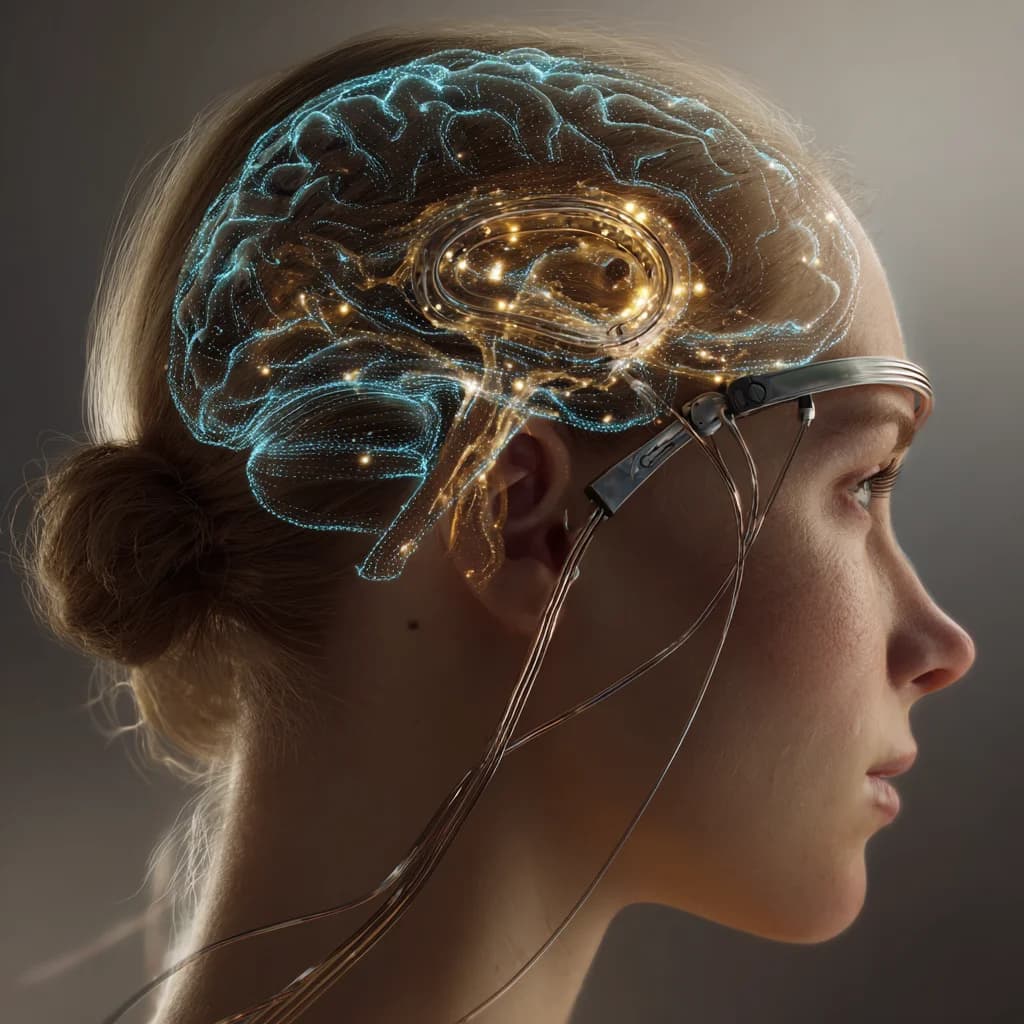
Brain-computer interfaces (BCIs) enable direct communication between the brain and external devices. Rather than using our hands to type or our voices to speak, BCIs read neural signals directly and translate them into commands, or send information directly into the brain.
This technology represents the first step toward the Merge: the integration of biological and artificial intelligence.
Current Applications
BCIs are already helping people with disabilities:
Motor restoration: Paralyzed patients can control robotic arms, computer cursors, or their own muscles through stimulation, using implanted electrodes that read motor intentions.
Sensory restoration: Cochlear implants provide hearing to the deaf. Retinal implants are beginning to restore vision. These bypass damaged sensory organs to stimulate the brain directly.
Deep brain stimulation: Implanted electrodes treat Parkinson's disease, depression, and OCD by modulating neural activity in specific brain regions.
Seizure prediction: Implants can detect approaching epileptic seizures and warn patients or trigger preventive stimulation.
Types of BCIs
Invasive: Electrodes implanted directly in brain tissue. Highest signal quality but requires surgery and risks infection or rejection. Examples: Utah arrays, Neuralink.
Partially invasive: Electrodes placed on the brain surface (electrocorticography) or within blood vessels. Lower risk than full implants, moderate signal quality.
Non-invasive: External sensors like EEG caps that read signals through the skull. Safest but lowest resolution and bandwidth.
Key Players
Neuralink: Elon Musk's company developing high-bandwidth implantable BCIs. Has implanted multiple human patients through its PRIME study, with recipients controlling computers entirely through thought. Uses a surgical robot to insert 64 ultra-thin threads carrying 1,024 electrodes.
Synchron: Uses a stent-based approach, threading electrodes through blood vessels to the brain, avoiding open brain surgery.
Blackrock Neurotech: Provides Utah arrays used in most current BCI research, with FDA breakthrough device designation.
Precision Neuroscience: Slides a thin-film electrode array onto the brain's surface through a narrow slit in the skull, and received FDA 510(k) clearance in 2025 for temporary implantation.
Future Vision
Today's BCIs are therapeutic, helping disabled people regain lost function. The transhumanist vision goes further:
Cognitive enhancement: Memory augmentation, accelerated learning, direct knowledge download.
Communication: Telepathy-like brain-to-brain communication, faster than speech.
AI integration: Direct access to AI capabilities, expanding human intelligence.
New senses: Perceive infrared, magnetic fields, or internet data streams.
Challenges
Bandwidth: Current implants record from around a thousand channels. The brain has 86 billion neurons. Bridging this gap requires orders of magnitude improvement.
Longevity: Implants degrade over time as the body rejects foreign materials. Lifetime implants require new materials science.
Safety: Any device that can write to the brain raises concerns about hacking, manipulation, and unintended effects.
Understanding: We still don't fully understand neural coding, how the brain represents information, limiting what BCIs can do.
Each of these is an engineering problem with well-funded teams attacking it, and patients are already living with the first generation of devices.
Related Concepts


Thinkers Exploring This


Related Articles