For decades, humanoid robots were a punchline. Dancing demos at conferences. Clumsy falls on YouTube. Prototypes that could barely open a door, let alone do useful work. The humanoid form factor was dismissed as impractical vanity; wheels and arms on rails could do the job better.
Then, sometime in 2025, they started working. And almost nobody noticed.
What Happened in 2025
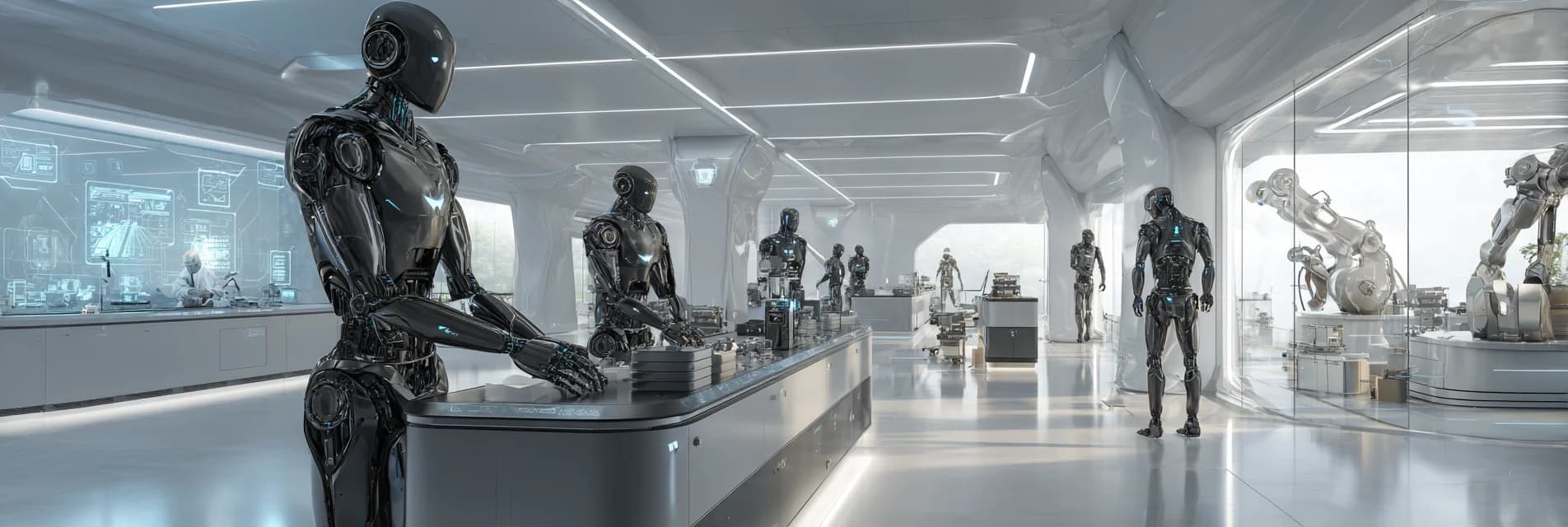
Two Figure 02 robots walked onto the floor of BMW's Spartanburg plant in January 2025. Eleven months later, they had worked over 1,250 hours of ten-hour shifts, loaded more than 90,000 parts, and helped produce 30,000 BMW X3 vehicles. Figure then retired the entire 02 fleet and announced the transition to Figure 03. The robots had already paid for themselves.
A humanoid robot, in a real factory, doing real work, on a real production line, for nearly a year. No teleoperation. No babysitting. Just a machine showing up and doing the job.
And BMW was just one data point.
At Tesla's Giga Texas, over a thousand Optimus units now handle delicate components autonomously on the factory floor. Ashok Elluswamy, who built Tesla's Autopilot, was moved to lead the Optimus program. That is a signal worth reading: Tesla sees humanoid robotics and autonomous driving as the same problem. AI that acts in the physical world.
1X Technologies launched NEO, a humanoid robot marketed directly to consumers, for $20,000. It weighs 66 pounds, lifts 150, and runs quieter than a whisper. You can buy one. For the price of a used car, you can put a humanoid robot in your home. EQT committed to deploying 10,000 units across its global portfolio by 2030.
In China, Unitree sold roughly 5,000 G1 units in six months at $13,500 each. AgiBot rolled its 5,000th humanoid off the production line. These are volume numbers.
And then there were the robot Olympics. In August, the World Humanoid Robot Games brought 280 teams, 500 robots, and 16 countries to Beijing for 26 competitive events: sprinting, football, boxing, cleaning. Unitree's H1 won gold in the 1,500 meter, 400 meter, 4x100 relay, and 100 meter hurdles. This happened and barely made the news. We are apparently already bored by athletic humanoid robots.
At CES 2026, Boston Dynamics unveiled a production-ready Electric Atlas with early units claimed by Hyundai and Google DeepMind. Hyundai, Boston Dynamics' parent, announced $26 billion in US investment through 2028 and targeted annual production capacity of 30,000 humanoid units by 2028-2030. Google invested $350 million in Apptronik and demonstrated Gemini running on the Apollo robot, understanding voice commands and solving tasks on its own.
The evidence has passed the threshold of ambiguity. Humanoid robots are in production, in factories, and for sale.
Why Everything Unlocked at Once
The question worth asking is why 2025 and not 2015 or 2005. The hardware has been adequate for years. Actuators, sensors, batteries, materials science: all sufficient. The bodies were ready. What was missing was a mind worth putting inside them.
A robot that can walk but cannot understand what it is walking toward is a toy. A robot that can grasp objects but cannot decide which object to grasp is a demonstration. Large language models and vision-language models changed this equation entirely. When you give a robot the ability to see, reason about tasks, understand spoken instructions, and plan sequences of actions, the body becomes useful. Google DeepMind's partnership with Boston Dynamics makes the architecture explicit: Gemini provides the mind, Atlas provides the body.
The convergence happened fast because the AI capability curve is exponential while the hardware curve was quietly linear for a decade. The bodies matured in the background. The minds caught up in a rush. The moment they met, everything unlocked at once.
This is why it feels sudden. The two curves crossed, and a technology that seemed perpetually five years away became real overnight.
The Exponential Ramp
In 2023, the state of the art was a robot sorting objects in a lab with a 60% success rate. In 2024, Figure 02 demonstrated a 7x improvement at BMW. In 2025, robots completed real production shifts. In 2026, every major manufacturer has a humanoid program with paying customers.
That progression should look familiar. Chess AI went from "interesting" to "superhuman" in a few years. Image generation went from "blurry" to "indistinguishable from photography" in eighteen months. Protein folding went from "unsolved for fifty years" to "solved" in a single model release.
Every exponential looks flat until it goes vertical. With humanoid robots, we just hit the vertical part.
The critical difference between embodied AI and software AI is the size of the market it addresses. Software AI automates cognitive tasks. Embodied AI automates physical tasks. Manufacturing, logistics, construction, agriculture, elder care, household work: these categories of labor are an order of magnitude larger than the entire software industry. Every one of them requires a body.
The Deeper Implications
The immediate impact is industrial. Factories and warehouses are designed for human bodies: conveyor heights, aisle widths, tool handles, control panels. A humanoid robot works in these environments without any redesign. A wheeled robot or a fixed arm cannot. This pragmatic argument for the humanoid form is the reason every major manufacturer is converging on it.
But the deeper implications are civilizational.
Every developed nation is sleepwalking into an elder care crisis. Populations are aging faster than caregivers can be trained. Japan, Germany, South Korea, and increasingly the United States face a future where there simply are not enough people to care for the elderly. A humanoid robot that can help someone out of bed, prepare a meal, and assist with daily tasks does not solve loneliness, but it solves physical dependency. For millions of people, that is the difference between dignity and institutionalization. Humanoid robots may be the only solution that scales.
Then there is the off-world case. Building infrastructure on the Moon or Mars requires dexterous manipulation in environments that will kill unprotected humans in minutes. Sending robots that can use the same tools, operate the same equipment, and navigate the same terrain as humans is the most practical path to becoming a multiplanetary species. We will colonize space with humanoid robots before we colonize it with humans.
The Goal All Along
The common reaction to capable humanoid robots is anxiety about job displacement. I understand the instinct but do not share it.
The entire arc of technology, from the first stone tool to the latest neural network, has been a project of liberation from labor. We do not mourn the displacement of washerwomen by washing machines or human calculators by electronic ones. Those transitions are celebrated in retrospect, even though they caused disruption at the time.
Humanoid robots are the final chapter. When machines can perform all physical labor, and AI can perform all cognitive labor, humanity is free from the necessity of work entirely. What we do with that freedom is the most important question of the coming decades. But the freedom itself is the goal. It has always been the goal.
The transition will be painful. Industries will restructure. Skills will become irrelevant. But the alternative, preserving human drudgery because change is uncomfortable, is the argument of every generation that feared the loom, the tractor, and the computer. They were wrong every single time.
The Substrate Assembles
Most conversations about the Singularity focus on cognitive intelligence: AI that thinks faster, reasons better, surpasses human minds. But intelligence without a body is intelligence without agency in the physical world. A mind that can outthink every human alive but cannot pick up a wrench is powerful and constrained.
Humanoid robots remove that constraint. They give AI the ability to act on the physical world with the dexterity and flexibility of a human. When that happens, the feedback loop between intelligence and capability becomes total. AI can conceive of a better chip and then build it. Design a better robot and then manufacture it. The recursive self-improvement loop that drives the intelligence explosion extends from software into hardware, from the digital world into the physical one.
This is what we are watching. The substrate of superintelligence is assembling itself in real time. The minds are being built in AI labs. The bodies are rolling off production lines. The convergence of the two is the event that changes everything.
The View From Here
I have been writing about the Singularity for over twenty years. For most of that time, humanoid robots felt like the furthest-out piece of the puzzle. AI was advancing, compute was scaling, but the machines in the physical world remained stubbornly limited. Robots could win at chess and fold proteins but could not fold laundry.
That era ended in 2025. Humanoid robots built cars, competed in athletics, went on sale to consumers, and deployed at commercial scale across multiple countries. In January 2026, every major robotics company announced production systems with full order books.
The machines have bodies now. The world that follows will be as different from ours as the industrial age was from the agrarian one. Probably more so.
The robots are already at work. They are not waiting for us to be ready.
Related Articles