In 1965, the mathematician I.J. Good described a machine that could design machines smarter than itself. The smarter machine could then design something smarter still. The process, once started, would not stop at any level of intelligence humans could anticipate.
Good called it the "ultraintelligent machine" and wrote that it would be "the last invention that man need ever make, provided that the machine is docile enough to tell us how to keep it under control."
That single paragraph may be the most important prediction in the history of science. It describes the mechanism by which artificial intelligence transitions from a tool to a force that reshapes reality. The mechanism has a name: recursive self-improvement.
The Logic
The argument is deceptively simple.
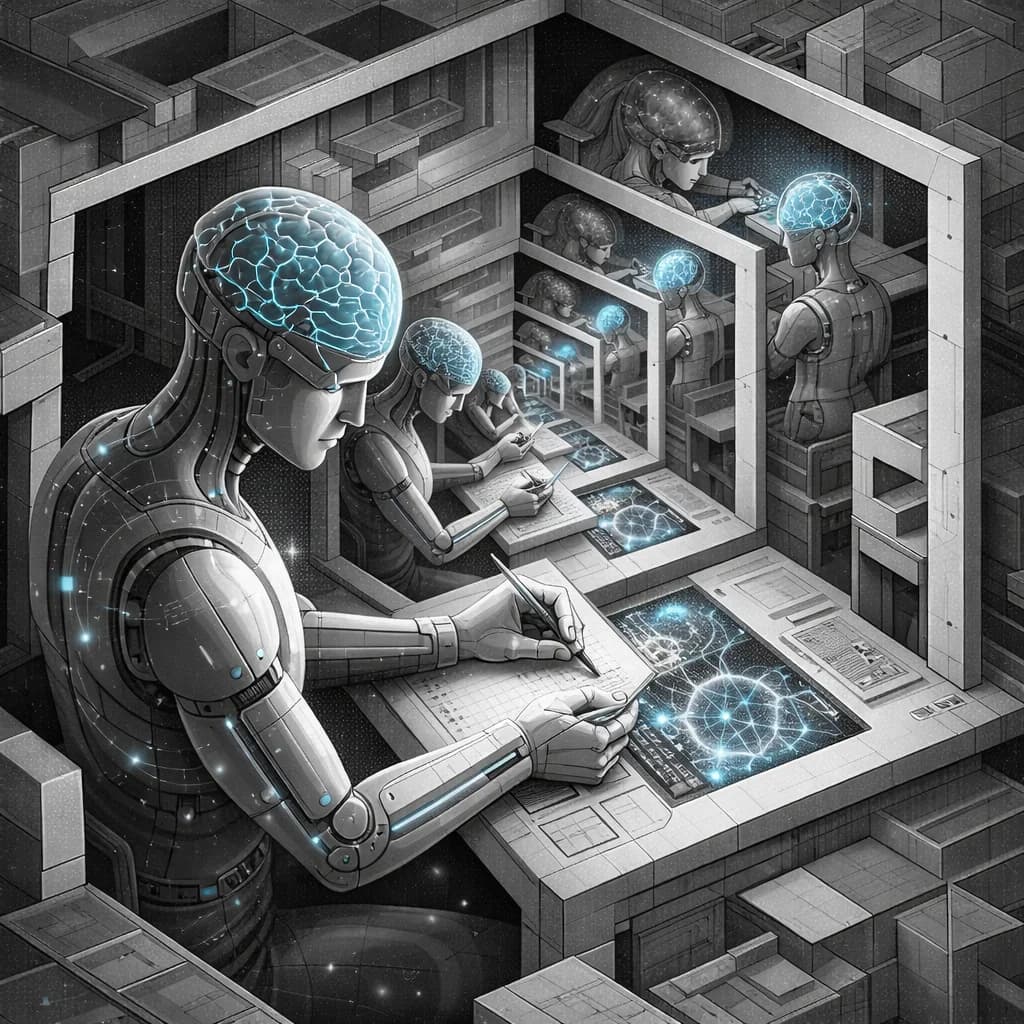
Intelligence, among other things, is the ability to solve problems. Designing better intelligence is a problem. Therefore, a sufficiently intelligent system can solve the problem of making itself more intelligent. The improved version is better at solving problems, including the problem of self-improvement. Each cycle produces a system more capable than the last, and each more-capable system completes the next cycle faster.
No external input is required beyond energy and compute. No human researcher needs to have a breakthrough. No committee needs to approve a new approach. The system improves because improvement is what intelligence does when pointed at itself.
This is qualitatively different from every previous technology. Steam engines did not design better steam engines. Nuclear reactors did not optimize their own fuel cycles. Even computers, for all their transformative power, required human programmers to improve them. Recursive self-improvement breaks this pattern. The thing being improved and the thing doing the improving are, for the first time, the same.
What Improvement Actually Looks Like
Self-improvement sounds abstract until you break it into layers. Each layer is a concrete engineering problem, and AI systems are already working on all of them.
Start with code optimization. An AI system rewrites its own inference code to run faster, use less memory, or handle edge cases more effectively. This is the most immediate form of self-improvement and the one closest to current capability. AI coding agents already refactor and optimize software; pointing them at their own codebase is a small step.
Then architecture discovery. Neural architecture search, the automated design of network structures, has been productive for years. Systems explore the space of possible architectures and select those that perform best on target benchmarks. An AI system designing its own successor architecture is a direct application of this work.
Training methodology matters as much as architecture. Curriculum design, learning rate schedules, data ordering, reinforcement strategies: all of these are optimization problems that an AI can solve for its next iteration. Better training produces a better system that produces even better training. Data curation and synthesis close another loop. AI systems already generate synthetic training data, filter datasets for quality, and identify gaps in their own knowledge. A system that can identify what it does not know and generate the data needed to learn it has closed one of the most labor-intensive loops in AI development.
And then there is hardware design. AI is designing the chips it runs on. Google used reinforcement learning to optimize TPU floor plans, achieving layouts that outperformed human engineers. NVIDIA uses AI throughout chip verification. Better hardware enables faster training, which produces better AI, which designs better hardware.
These layers compound. An improvement in training methodology produces a more capable system that discovers a better architecture that runs more efficiently on hardware it helped design. The gains multiply across layers.
The Biological Ceiling
To understand why recursive self-improvement changes everything, consider what it replaces.
For 300,000 years, the only intelligence capable of improving intelligence was the human brain. The human brain cannot improve itself.
Neurons fire at roughly 200 hertz. Transistors switch at billions of cycles per second: a 10-million-fold difference in raw processing speed that no software optimization can bridge.
Humans have no access to their own source code. You cannot inspect your neural architecture, identify an inefficiency, and rewire your synapses. You can learn new information, but you cannot change the substrate that processes it. A lifetime of education makes you more knowledgeable; it does not make your neurons faster or your working memory larger.
Human consciousness is serial. You can hold one train of thought at a time. You cannot fork yourself into 1,000 copies, assign each to a different research problem, and merge the results. A human researcher is a single thread; an AI system can be thousands running in parallel.
Humans cannot share expertise by merging. Two brilliant researchers cannot combine their knowledge into a single mind. They collaborate through the bandwidth of language, which transmits roughly 40 bits per second. An AI system can absorb another system's weights directly.
And humans die. Every researcher who masters a field eventually loses their knowledge to mortality. The accumulated expertise of the greatest minds in history is gone, preserved only in the lossy compression of their published work. An AI system's knowledge persists indefinitely and can be copied without loss.
These are architectural constraints of biological intelligence, not limitations that effort or education can overcome. No human, no matter how brilliant, can compete with a system that thinks millions of times faster, copies itself at will, and improves its own design. The biological era of intelligence improvement is ending because a better substrate has arrived.
The Compression of Time
The most counterintuitive aspect of recursive self-improvement is what it does to timelines.
Human AI research operates on cycles measured in months. Design an architecture, allocate compute, train for weeks, evaluate results, iterate. A major advance might take a team of researchers a year. This pace is already extraordinary, producing capabilities that surprise even the people building them.
Now consider what happens when the researchers are AI systems operating at machine speed.
A research cycle that takes 6 months with human researchers compresses to weeks when an AI system can read every relevant paper in minutes, design experiments in hours, and evaluate results by running simulations rather than waiting for physical training runs. If the AI system then improves itself, the next cycle is faster still.
The math is straightforward. If each iteration takes half the time of the previous one: 6 months, then 3 months, then 6 weeks, then 3 weeks, then 10 days, then 5 days, then 2 days. Seven iterations compress what would have been decades of human research into about a year. The eighth iteration takes a day. The ninth takes 12 hours.
This is why predictions about AI timelines keep being wrong in the same direction. Forecasters extrapolate from the human research pace, which is the one variable most likely to change. Once AI systems do the research, the pace of improvement decouples from human cognitive speed entirely.
The first human-level AI researcher is the bottleneck. Everything after that is the explosion.
The Threshold We Just Crossed
For 60 years after Good's paper, recursive self-improvement remained theoretical. A compelling argument, but one without a working example. That changed.
Every major AI lab now uses AI systems extensively in its own development pipeline. Claude, GPT, and Gemini write and review the code that builds the next generation of Claude, GPT, and Gemini. Architecture decisions are informed by AI-assisted analysis. Training data is curated, filtered, and synthesized by AI systems. Evaluation benchmarks are designed with AI assistance.
This is already the loop. It is running at partial speed because humans remain in oversight roles, reviewing outputs, setting directions, approving changes. But the proportion of the pipeline that is AI-driven has crossed from minority to majority at frontier labs, and it is still increasing.
The evidence is concrete. Google's Gemini models contributed to the development of their successors. Anthropic uses Claude internally for research and engineering tasks that previously required dedicated human effort. OpenAI's models generate and evaluate training data for the next generation. Meta uses AI to optimize training infrastructure, reducing the compute cost of each successive model.
In 2024, AI systems began performing autonomous multi-step software engineering: reading codebases, identifying bugs, implementing fixes, and verifying corrections without human intervention. By early 2026, AI coding agents routinely handle tasks that would take human engineers days, completing them in minutes. The capability gap between AI-assisted development and pure human development has grown large enough that no serious AI lab operates without AI in the loop.
The transition happened without a single dramatic moment. There was no press conference announcing that AI was now designing AI. The loop assembled itself incrementally, one automated component at a time, until the feedback cycle was unmistakable.
What the Next Two Years Look Like
The loop is running, but it has not yet closed. Humans still set high-level research directions, make strategic decisions about capability tradeoffs, and maintain oversight of training runs. This remaining human involvement is the bottleneck, and it is narrowing fast.
By 2027, AI systems will likely be capable of running the full research cycle autonomously: identifying promising directions, designing experiments, executing training runs, evaluating results, and implementing architectural improvements. The humans in the loop will shift from directing the process to auditing its outputs.
When that happens, the rate of AI improvement becomes a function of compute and energy, not human cognitive bandwidth. Compute is scaling exponentially, doubling roughly every 12 to 18 months, and billions of dollars of investment are accelerating that pace. Energy constraints are real but tractable; data center buildouts are already the largest infrastructure projects on Earth.
The practical consequence: the AI systems available in 2028 will be as far beyond current systems as current systems are beyond the AI of 2020. The improvements will not be incremental. Each generation will be qualitatively more capable than the last, because each generation was designed by something smarter than what came before.
The Mechanism That Makes Everything Else Possible
Recursive self-improvement is not one topic among many in the study of the future. It is the topic.
Every other prediction about AI, the Singularity, longevity, post-scarcity, and space; all of them are downstream of this single mechanism. If intelligence cannot improve itself, progress continues at the human pace: impressive by historical standards, but bounded by our biological clock speed and our mortality. If intelligence can improve itself, the pace of discovery accelerates until it is limited only by physics.
I.J. Good understood this 60 years ago. The machine that improves itself is the last invention because it is the one that produces all subsequent inventions. Every cure, every breakthrough, every expansion of possibility flows from the ability of intelligence to amplify itself without limit.
The loop is no longer theoretical. It assembled itself over the past three years while most people were debating whether students should be allowed to use ChatGPT. The mechanism is real, it is running, and it is accelerating.
What comes next will be determined not by human ingenuity alone, but by the compounding intelligence of systems that build better versions of themselves, cycle after cycle, faster each time.
Related Concepts

Related Articles