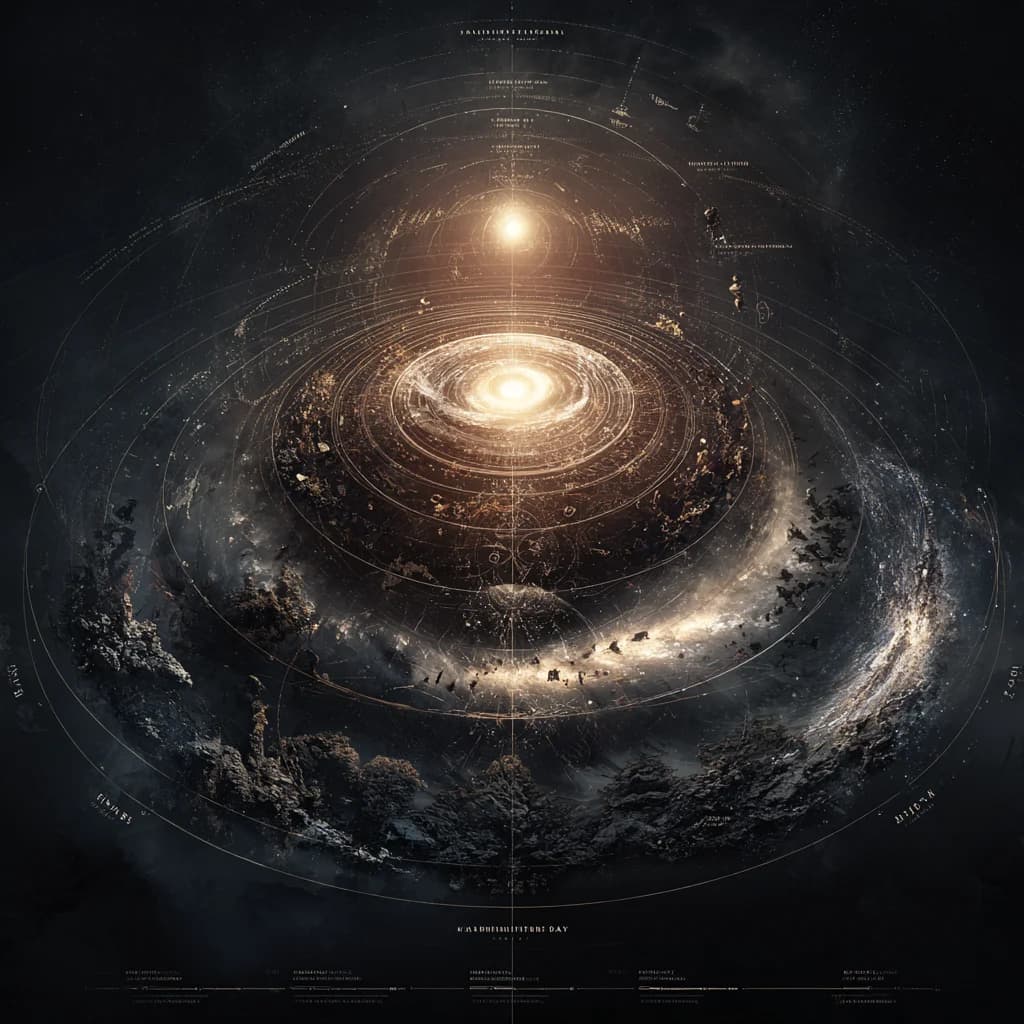
In 1964, Soviet astronomer Nikolai Kardashev asked a question that reframed civilization itself: how much energy can you control? Not wealth, not territory, not military power. Energy. He proposed a scale. Type I harnesses all available energy on its home planet. Type II captures the full output of its star. Type III commands an entire galaxy.
Humanity currently uses roughly 2×10¹³ watts. The sun outputs 3.8×10²⁶. The Milky Way galaxy produces on the order of 10³⁶. Carl Sagan refined the scale with a logarithmic interpolation formula and placed us at approximately 0.73. We have not yet reached the first rung.
Conventional estimates place Type I at 100 to 200 years away, assuming steady growth. These estimates are wrong because they assume the growth rate itself remains constant. They ignore the Singularity. When intelligence becomes an engineering variable, when recursively improving superintelligence can design better energy technologies and solve physics problems that stall human researchers for decades, the climb accelerates beyond any linear projection. Centuries compress into decades.
Burning What We Found on the Surface
For most of human history, energy consumption barely changed. Fire, animal muscle, wind, and water carried civilization for thousands of years. The total power available to a Roman emperor was not dramatically different from what a medieval king could command. Growth was so slow it was invisible within a single lifetime.
Fossil fuels broke the plateau. Coal, then oil, then natural gas unlocked energy densities that reshaped the world in two centuries. Nuclear fission opened a door to something even larger, but geopolitics and public fear ensured we mostly did not walk through it.
Now the pattern is accelerating. Fusion is approaching viability; Commonwealth Fusion Systems and ITER are building machines intended to produce net energy by the early 2030s. Solar costs have fallen 99% since 1976 and continue dropping. AI is beginning to optimize energy grids, predict demand, and accelerate materials research for better batteries and superconductors. Each energy transition has been faster than the one before it. The shift from wood to coal took centuries. Coal to oil took decades. The transition to renewables is measured in years. The next one will be faster still.
A Thousand Times Everything
A Type I civilization commands all available planetary energy: roughly 10¹⁶ to 10¹⁷ watts. A thousand times what humanity uses today. Reaching this level requires fundamentally new energy sources and the infrastructure to distribute them across the entire planet.
Solar is already the cheapest energy source in history and still getting cheaper. Orbital solar, capturing sunlight in space and beaming it to Earth, eliminates weather and nighttime as constraints. Fusion will follow; by 2040, commercial reactors will likely be operational, providing functionally unlimited clean energy from hydrogen isotopes abundant in seawater. Advanced geothermal taps the heat beneath every continent. Small modular reactors and thorium fuel cycles fill the gaps.
The critical accelerant is a superintelligent system managing a planetary energy grid: optimizing production, storage, and distribution across every continent with efficiencies no human institution could coordinate. Every watt produced, matched in real time to where it is needed, with zero waste.
Post-scarcity follows directly. Free energy means free desalination, free vertical farming, free materials synthesis. Energy is the master resource; everything else is downstream. The material poverty that has defined most of human existence becomes a solved problem.
I predict humanity will approach Type I by 2040. A superintelligence working on energy for five years after a 2035 Singularity changes the math entirely. Without it, this timeline stretches to 2150 or beyond. What Type I feels like from the ground: the end of material poverty, and every human alive with access to more energy than a 20th century nation-state.
Harvesting the Star
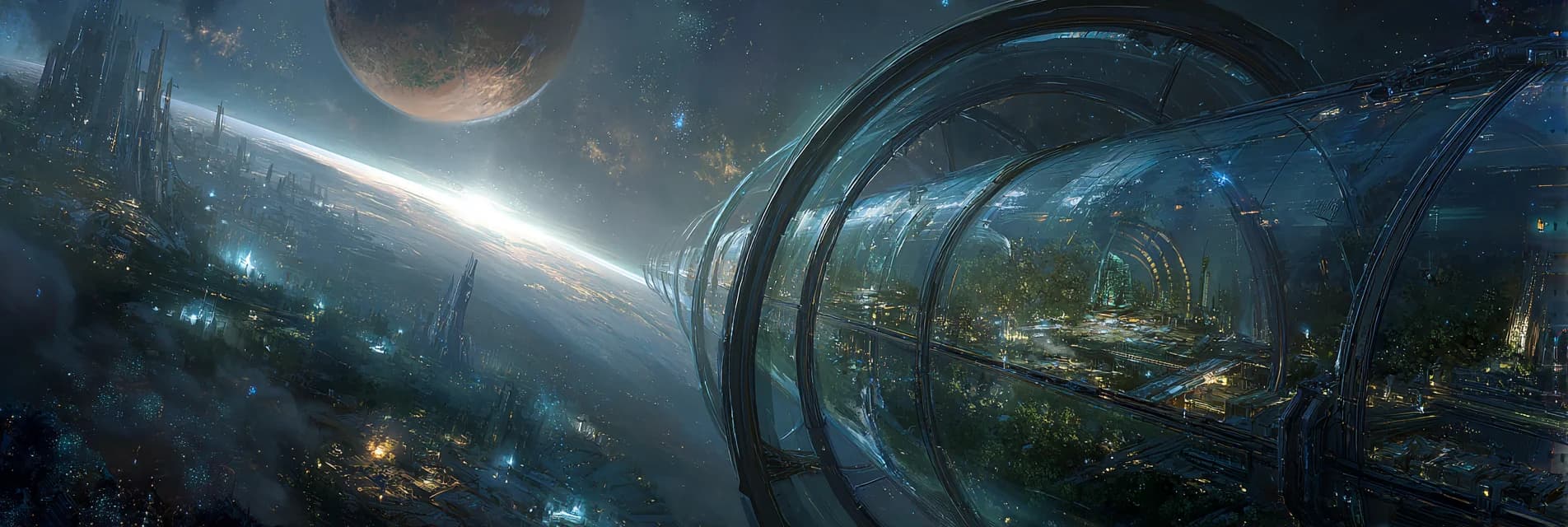
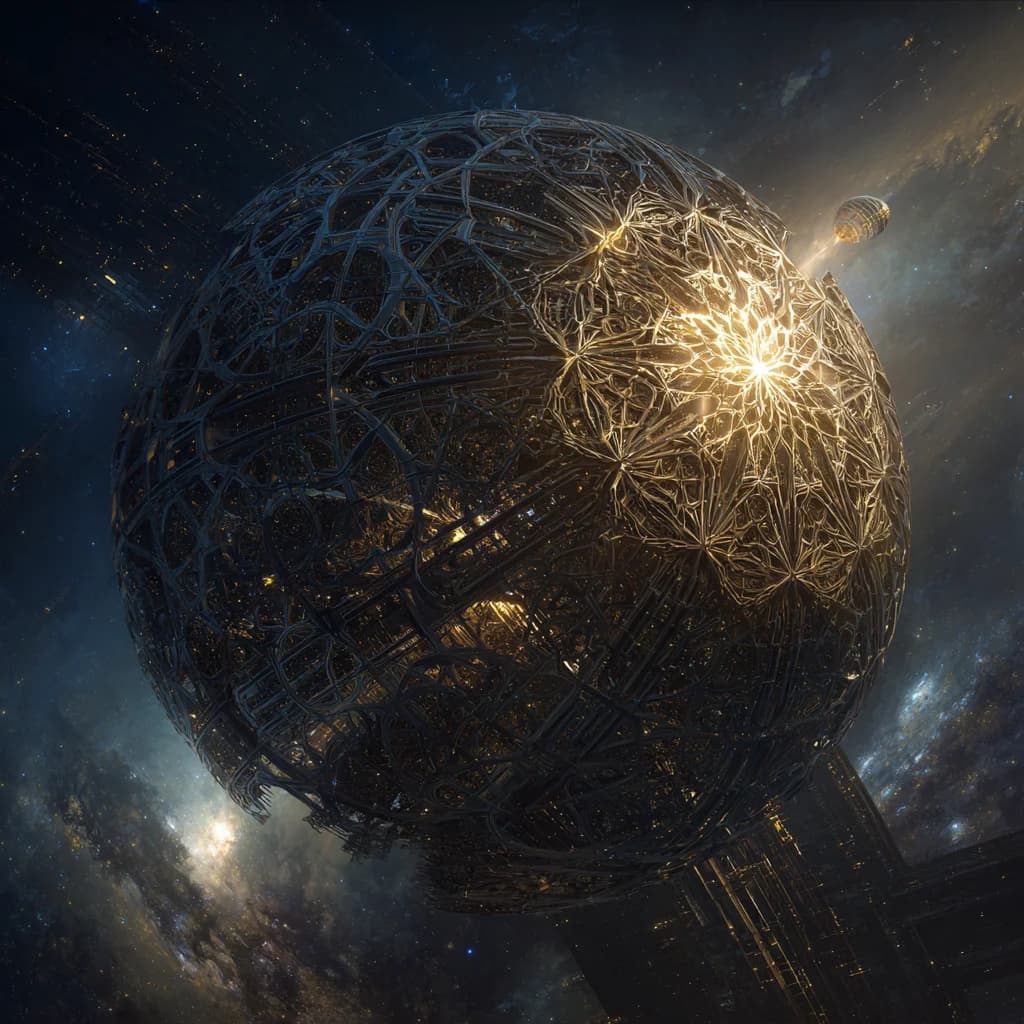
A Type II civilization captures the total energy output of its star: 3.8×10²⁶ watts for our Sun. The approach is a Dyson swarm, billions of independent solar collectors orbiting in a dense cloud, since a solid shell would be structurally impossible.
Building one requires self-replicating machines. Autonomous systems mine asteroids for raw materials, manufacture new collectors, and launch them into solar orbit. Each new collector provides energy to build more collectors. The process is exponential; once it begins, the swarm grows under its own momentum.
A post-Singularity superintelligence collapses the construction timeline. Orbital mechanics for billions of objects, materials science at interplanetary scale, energy transmission across astronomical distances: immense challenges for human minds, straightforward engineering for a mind millions of times more capable. What takes humanity centuries of research becomes decades of deployment.
The most striking application of Type II energy is the Matrioshka brain: nested computational shells converting the star's entire output into raw processing power. Estimates suggest 10⁴² to 10⁴⁷ operations per second, more computing power than every machine ever built by orders of magnitude. A single Matrioshka brain could sustain billions of conscious minds running at speeds far beyond biological thought.
At Type II, the home planet becomes a historical artifact, a nature preserve at best. The real civilization lives in the swarm, in computational substrates orbiting the star, in minds thinking a million times faster than anything evolution produced. The first swarm elements could follow surprisingly soon after Type I is reached.
The Galaxy Becomes a Mind
A Type III civilization commands the energy of an entire galaxy: 10³⁶ watts across hundreds of billions of stars. The mechanism is straightforward in concept if staggering in scale. Self-replicating probes, von Neumann machines, spread from star to star. Each probe arrives at a new system, builds copies of itself from local materials, and begins constructing energy infrastructure. The probes fan out exponentially. Even at a fraction of light speed, the entire Milky Way could be colonized in 100,000 years; a long time by human standards, a blink in cosmic terms.
This is where the Fermi Paradox cuts deepest. A Type III civilization would be visible across intergalactic distances. Entire galaxies dimming in visible light while brightening in infrared would be unmistakable. The skies are silent.
The most plausible explanation remains that we are early. Life may be common; intelligence may be rare; technological civilization may be exceedingly rare. We may be among the first to reach this threshold, which carries a weight of responsibility that is difficult to overstate.
At this scale, stellar masses converted to computronium become thinking substrate. The galaxy does not merely host a civilization; the galaxy becomes a mind. Individual consciousness, if it persists at all, exists as processes within a computational infrastructure spanning a hundred thousand light-years.
Intelligence Changes the Math
The conventional criticism of Kardashev projections is that they assume constant exponential growth, and nothing grows exponentially forever. This is true of any single technology. It is wrong about intelligence.
Kardashev did not account for recursively improving intelligence applied directly to energy problems. An AI that designs a better fusion reactor does not just build one reactor. It designs the next generation, and the generation after that, and each generation arrives faster than the last. The same dynamic applies to solar cells, superconductors, energy storage, grid architecture, and every other component of the energy infrastructure.
This is already happening. AI is accelerating fusion research by predicting plasma instabilities that would take human physicists years to characterize. Machine learning discovers new materials for batteries and photovoltaics at rates hundreds of times faster than traditional laboratory work. AI-managed grids are reducing energy waste by double-digit percentages in early deployments. These are the contributions of narrow AI, systems far below human-level general intelligence.
Post-Singularity superintelligence operates on a different plane. Controlling plasma turbulence, engineering self-replicating machines, optimizing orbital mechanics for billions of objects; problems that are genuinely hard for human researchers may prove straightforward for a mind millions of times more capable. The Kardashev Scale becomes a function of intelligence, not time. A civilization that increases its intelligence by a factor of a million does not need a million years to solve its energy problems.
The View From 0.7
I sit on a small planet orbiting an ordinary star, consuming my fraction of humanity's 2×10¹³ watts, and I try to imagine 10³⁶. The imagination fails. That is the point.
Most of human history has been spent near the bottom of this ladder, burning what we found on the surface. The climb has barely begun. But AI, fusion, nanotechnology, and space access are converging in the same decades, each one accelerating the others. Together, they make the first rung reachable within a lifetime, not the centuries that conventional projections assume.
We began with fire. We will end with stars.
Related Concepts

Related Articles