Nanotechnology will become the key materials technology underlying all major developments during the 21st century. Already it is seeding breakthroughs in fields ranging from medicine to transportation to computing, and its impact will only accelerate in the coming decades.
Eric Drexler, the father of nanotechnology, laid out its initial conception in his 1986 seminal book Engines of Creation. Drexler is also the founder of the Foresight Nanotech Institute, an organization dedicated to the safe and beneficial implementation of nanotechnology.
Control at the Atomic Level
The term nanotechnology refers to a broad spectrum of technologies that utilize the ability to manipulate matter on a molecular or atomic level. From the forming of stone tools to the development of computers, humans have always been restricted to moving atoms and molecules in large herds. Even the development of silicon chips on the micrometer scale involves manipulating massive clusters of atoms. Nanotechnology transcends this limitation by giving precise control over every atom or molecule.
The implications of this kind of control are tremendous. Virtually anything could be constructed from cheap and abundant raw materials. Feed a nanoassembler sand and out comes a computer; feed it dirt and water and out comes any type of fruit or vegetable. Furthermore, molecularly assembled products will be far superior to anything constructed today. Nanotechnology will be able to construct materials many times lighter, stronger, smarter, and cleaner than current methods allow. The material cost of any product will shrink to pennies per pound, and its value will be determined solely by the information of its design.
What We've Already Built
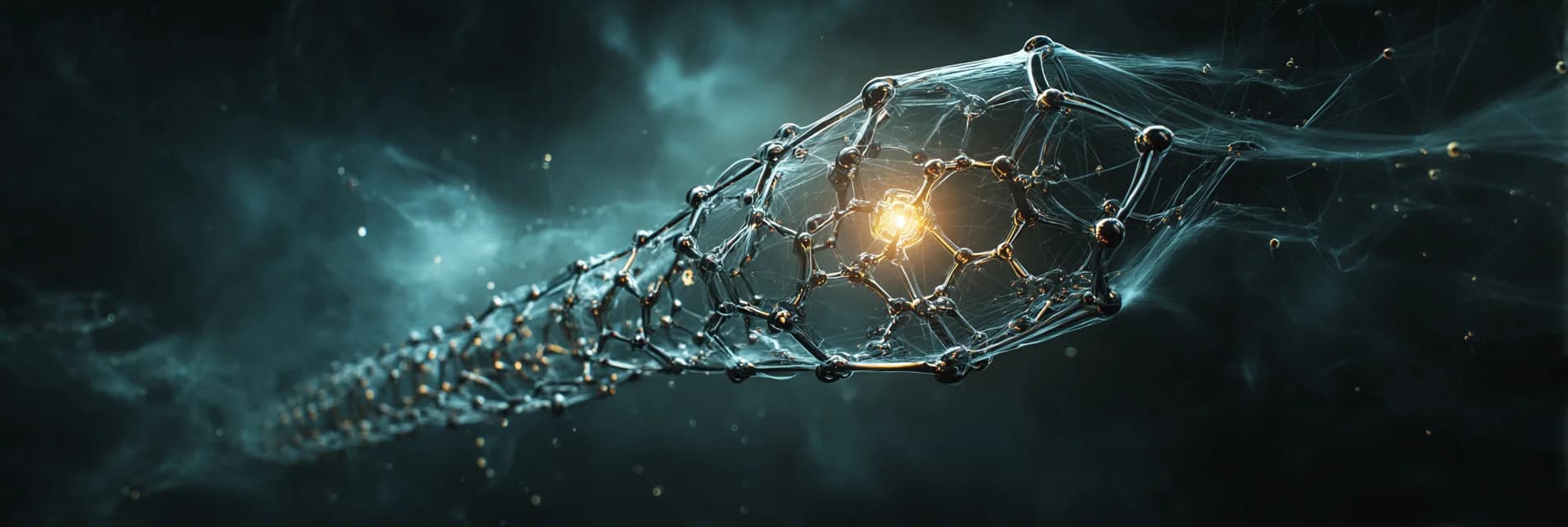
We have already seen the development of carbon nanotubes, cylindrical arrays of carbon atoms 1/100,000 times the thickness of a human hair. Nanotubes are an extremely durable substance that possess hundreds of times the strength of steel with only a fraction of its weight. They also exhibit both metallic and semiconducting properties, making them excellent candidates to replace the much larger and less efficient transistors of today's microelectronics. Nanotube-based electronics would produce computing devices billions of times faster while consuming far less energy.
But these materials represent only the beginning of what nanotechnology will become.
Nanobots
At the heart of nanotechnology exists the molecular-level machine, or nanobot. Nanobots the size of cells will be able to self-replicate, communicate with each other, and work together toward achieving any desired objective.
Nanobots injected into the bloodstream could continually clean and repair the body. They could kill pathogens, toxins, and cancer cells, repair DNA errors, and even take over biological functions and systems. This would not only provide radical life extension; it would make the body stronger, healthier, and more resilient than is biologically possible.
These benefits extend beyond the body to the brain. Nanobots injected into the blood vessels of the brain will be able to interact with our neurons to radically extend our biological intelligence and memory. In time, we will be able to completely replace the slow biological hardware of the mind with far superior nanomachinery.
Healing the Planet
Nanobots can also reverse the effects of pollution by breaking down damaging levels of carbon dioxide in the atmosphere. Furthermore, we won't have to rely on burning fossil fuels as our primary energy source. Nano-based fuel cells will provide a clean, safe, and inexpensive renewable source of energy.
The potential benefits of nanotechnology during the 21st century are unfathomable. From eliminating disease and death, to ending poverty and pollution, to providing unlimited resources and energy, nanotechnology will become indispensable to humanity.
The Danger
Any powerful technology can be misused, and nanotechnology is no exception. Some have raised concerns about "grey goo" scenarios or nano-weaponry. These concerns are worth noting but should not slow development. The benefits of nanotechnology far outweigh the risks, and the best defense against misuse is to accelerate beneficial applications.
The development of smarter-than-human intelligence will help us maximize the benefits of nanotechnology while minimizing risks. This is another reason to accelerate AI development: it gives us the tools to manage the powerful technologies we are creating.
Related Concepts
Related Articles