
Key Points
- •A nanoscale device capable of positioning atoms to construct complex structures
- •Core concept of Drexlerian nanotechnology and molecular manufacturing
- •Could manufacture any chemically stable structure from raw feedstock
- •Would enable material abundance: products cost only design and raw materials
- •Requires solving challenges in positional chemistry and thermal noise
The Universal Constructor
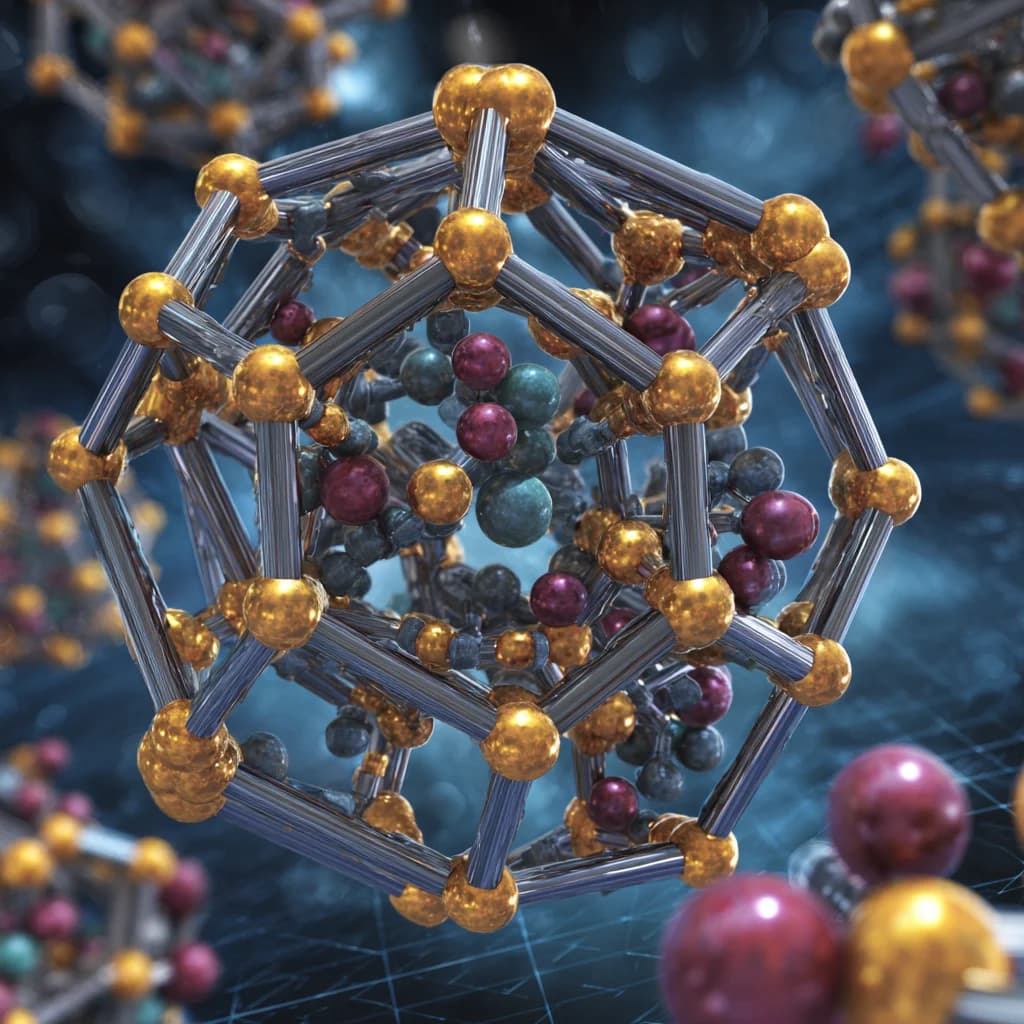
A molecular assembler is a proposed nanoscale device that can build virtually any chemically stable structure by positioning individual atoms and molecules with atomic precision. It represents the ultimate manufacturing technology, a universal constructor at the molecular level.
The concept was developed in detail by Eric Drexler in his technical work Nanosystems, which provides physics-based analyses of how such devices could work.
How It Would Work
A molecular assembler would operate through mechanosynthesis, using mechanical force to drive chemical reactions in specific locations:
Positioning system: A rigid framework with precisely controlled arms that can position reactive molecular tools with sub-angstrom accuracy.
Reactive tips: Molecular tools with specific chemical properties, able to pick up an atom from a feedstock molecule, carry it to the workpiece, and bond it in place.
Control system: A computer directing the sequence of operations, like a CNC machine but at the atomic scale.
Feedstock processing: Systems to break down raw materials into the specific atoms and molecular fragments needed for construction.
The Biology Precedent
Life proves that molecular assembly works. Ribosomes build proteins by reading genetic instructions and assembling amino acids in precise sequences. DNA polymerase copies genetic information with extraordinary fidelity. Enzymes catalyze specific reactions by positioning reactants precisely.
The challenge is engineering these capabilities into programmable, general-purpose machines rather than specialized biological systems.
Economic Implications
Molecular assemblers would transform manufacturing economics:
Near-zero marginal cost: Once you have the design and raw materials, copying a product costs essentially nothing.
Dematerialization of wealth: Physical goods become as copyable as digital files.
Radical customization: Every product can be optimized for its specific use case.
Waste elimination: Products can be disassembled and their atoms reused for new products.
Technical Challenges
Building molecular assemblers requires solving several hard problems:
Thermal noise: At room temperature, atoms vibrate constantly. Assemblers must work despite this, or operate at very low temperatures.
Stiffness: The positioning system must be rigid enough to place atoms accurately despite thermal vibrations and reaction forces.
Tooling: We need a complete set of molecular tools for all the reactions required to build arbitrary structures.
Bootstrapping: Building the first assembler requires precision we don't yet have, a chicken-and-egg problem.
Timeline and Prerequisites
Most researchers believe molecular assemblers require significant advances in AI and conventional nanotechnology first. The combination of AI for design and control, plus incremental advances in atomically precise manufacturing, could eventually enable Drexler's vision.
Estimates range from decades to a century, depending on how hard the remaining challenges prove to be, though AI-accelerated materials science and computational chemistry could compress the timeline substantially.
Related Concepts


Thinkers Exploring This


Related Articles