When someone dies, what actually happens? The heart stops. Oxygen ceases to reach the brain. Neurons begin to degrade. Within minutes, the electrochemical patterns that constituted a person's memories, personality, and identity start to dissolve.
But "start to dissolve" is not the same as "are destroyed." The information is still there, encoded in synaptic connections and molecular structures. It is degrading, but it has not vanished. If you could halt that degradation, freeze it in place, the information would be preserved.
This is the premise of cryonics: that death is a process, not an event, and that preserving the brain before information loss occurs gives future technology the opportunity to restore it.
The Argument
The logic is straightforward:
1. Identity is information. You are the pattern of your brain, not the specific atoms that compose it.
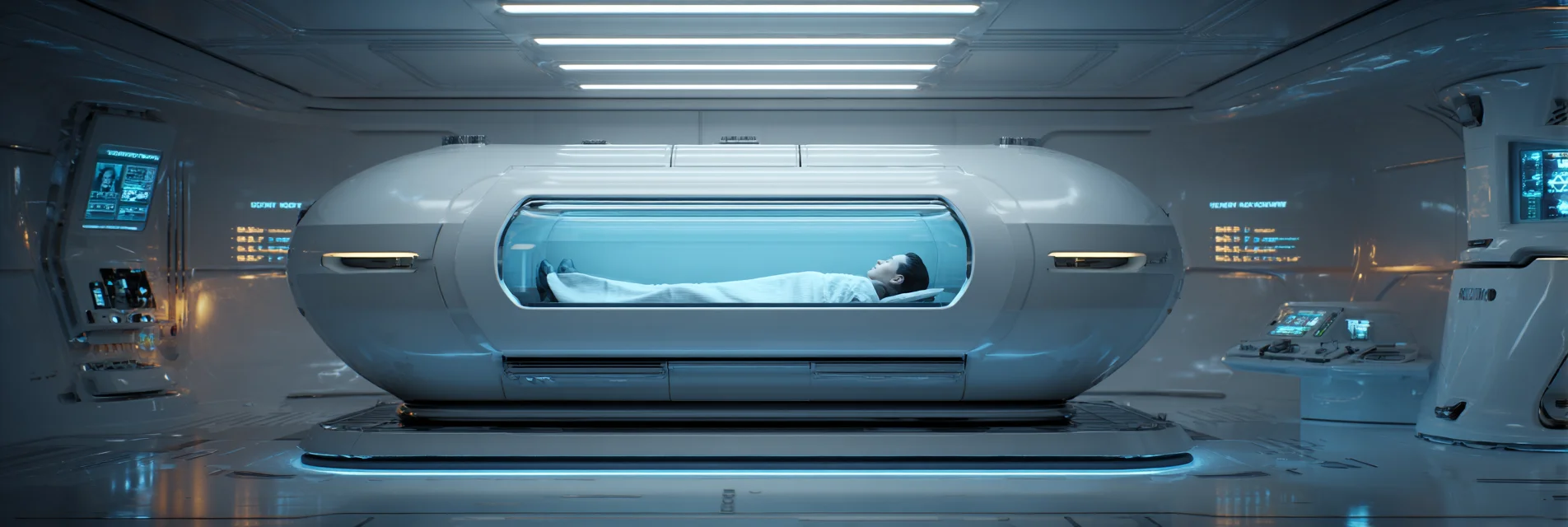
2. Cryopreservation preserves information. Vitrification (cooling tissue to cryogenic temperatures with cryoprotectants) prevents ice crystal formation and maintains cellular structure.
3. Future technology will be able to repair what we cannot repair today. Nanotechnology, advanced medicine, and molecular repair are progressing rapidly.
4. The alternative (burial or cremation) guarantees information loss.
Therefore, cryopreservation is a rational choice for anyone who values their continued existence and can afford it.
Note what this argument does not require. It does not require believing that revival is certain. It only requires believing that the probability is meaningfully greater than zero, and given the pace of AI and nanotechnology, that probability looks increasingly high.
Common Objections
"It won't work." Perhaps. But we don't know that it won't work. The history of medicine is a history of conditions once considered irreversible becoming treatable. Death by cardiac arrest was once final; now we have CPR and defibrillators. Cryonics is a bet that this pattern will continue.
"The damage is too severe." Vitrification has improved dramatically. Modern protocols preserve cellular ultrastructure well enough that memories are recoverable. We know memories are stored in synaptic connections; we can see these connections in vitrified tissue. The information is there.
"Even if you could repair the brain, the person would be gone." This is the philosophical objection, and it deserves serious consideration. But consider: you are not the same person you were ten years ago. Your atoms have been replaced. Your memories have shifted. Your personality has evolved. Yet you consider yourself continuous with that past self. Why would restoration from cryopreservation be categorically different from waking up after a night's sleep, or recovering from general anesthesia?
"It's too expensive." Cryopreservation costs approximately $100,000 to $200,000, typically funded through life insurance. This is less than many people spend on end-of-life medical care that extends life by months. If there is any chance of extending life by centuries, the calculation changes dramatically.
The Real Obstacle
The biggest obstacle to cryonics is not technical or financial. It is psychological.
Humans have evolved to accept death. Our cultures have developed elaborate frameworks (religious afterlives, celebration of legacies, natural cycles) to make mortality bearable. Cryonics disrupts these frameworks. It says: death is not acceptable, and we should fight it with every tool available.
This is uncomfortable. It requires admitting that death is bad, that the loss of a person's mind is a tragedy, that our acceptance of mortality is a coping mechanism rather than wisdom.
Most people would rather not think about this. They would rather trust in heaven, or reincarnation, or the comforting idea that death gives life meaning. These are not arguments against cryonics. They are psychological defenses against taking mortality seriously.
The Connection to the Singularity
Cryonics makes the most sense in the context of accelerating technological progress. If you believe that nanotechnology, artificial superintelligence, and radical life extension are coming but might not arrive in your biological lifetime, then cryonics is a bridge.
The scenario is straightforward: you are preserved today. In 15 or 30 years, technology advances to the point where cell-by-cell repair is possible. You are revived into a world that has solved aging, disease, and scarcity itself.
It is an extrapolation of current technological trends. The same people who built AlphaFold are working on problems that lead toward molecular repair. The same exponential progress in computing that produced large language models will eventually produce the tools needed to reverse cryopreservation damage.
Why I Chose This
This is not an abstract topic for me. In 2024, my father was cryopreserved at the Cryonics Institute in Michigan.
My father was a major part of how I think. He encouraged my curiosity, supported my interests, and never dismissed my ideas about the future as unrealistic. When I told him I believed we would solve death in our lifetimes, he listened. He was the first person I could talk to about the Singularity who took it seriously.
When he was dying, I faced a choice that most people never consider. The standard script: burial or cremation, a service, closure. Move on. Accept the loss as final.
But I had made this choice years earlier. In 2009, I signed up my entire family for cryopreservation at the Cryonics Institute. I had studied the arguments, understood the technology, and concluded it was the rational path. When the moment came, there was no agonizing decision to make. The plan was already in place.
I could not accept the alternative. I knew too much about what death actually is: information loss. The pattern that was my father, his memories, his way of thinking, his laugh, the specific way he approached problems, all of that was encoded in his brain. Burial destroys that information permanently. Cremation destroys it faster. I was not going to let that happen without a fight.
So I chose preservation. My father now rests at cryogenic temperatures in Michigan, his neural structure vitrified, the information that made him who he was held in suspension.
People ask if I believe it will work. That is the wrong question. Belief is not the standard. Probability is. The question is: what is the expected value of each choice? Burial offers zero probability of seeing him again. Cryopreservation offers a probability meaningfully greater than zero, and given the pace of AI and nanotechnology, that probability grows every year.
The cost was less than many people spend on end-of-life care that extends life by months. If there is any chance of extending life by centuries, the calculation is obvious.
I think about him often. The knowledge that he is not simply gone, that there is a door left open, changes grief into something else. Patience rather than closure. Anticipation of reunion rather than acceptance of loss.
Some will call this denial. I call it rational hope. The same technological trajectory that produced the AI I use daily, that is revolutionizing drug discovery and biological research, will eventually produce the tools for molecular repair. My father's pattern is preserved. The tools are coming.
The odds are better than most people think. The timeline is shorter than most expect. And the potential payoff is the only thing that ultimately matters: the chance to know someone again. To introduce him to what the world has become. To continue a conversation that death interrupted but did not end.
Every other value, every other goal, every other relationship depends on the people you love being there to share it. I made the only choice that preserves that possibility. I would make it again without hesitation.
Related Concepts

Related Articles