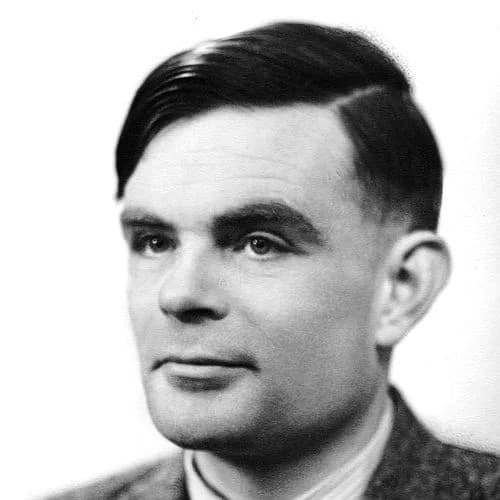
Alan Turing formalized the concept of computation itself. His 1936 paper on computable numbers established the theoretical foundation for every computer and AI system that followed. During World War II, Turing broke the Enigma cipher at Bletchley Park, demonstrating that machines could solve problems previously thought to require human intelligence. His 1950 paper "Computing Machinery and Intelligence" posed the question "Can machines think?" and proposed the Turing Test as a criterion for machine intelligence, a benchmark that shaped AI research for decades. Turing envisioned machines that could learn and adapt, anticipating neural networks and machine learning by half a century. He was prosecuted for homosexuality and died in 1954 at age 41. Every AI system running today exists downstream of his foundational work.
Key contributions
- Formalized computation with the Turing machine
- Proposed the Turing Test for machine intelligence
- Broke Enigma at Bletchley Park during WWII
- Laid theoretical foundations for AI and computer science
Quotes (1)
“We can only see a short distance ahead, but we can see plenty there that needs to be done.”
Computing Machinery and Intelligence · 1950