Key Points
- •Designing and building biological systems and organisms from scratch
- •CRISPR and AI-driven protein design have made custom biology routine
- •Applications span medicine, materials, energy, food, and environmental restoration
- •Bridge technology between genetic engineering and molecular nanotechnology
- •Accelerating exponentially as AI automates the design-build-test cycle
Life Becomes Programmable
For 3.8 billion years, biology evolved through blind selection. Organisms that survived reproduced; those that did not were forgotten. The process was powerful but glacially slow, constrained by random mutation and environmental pressure.
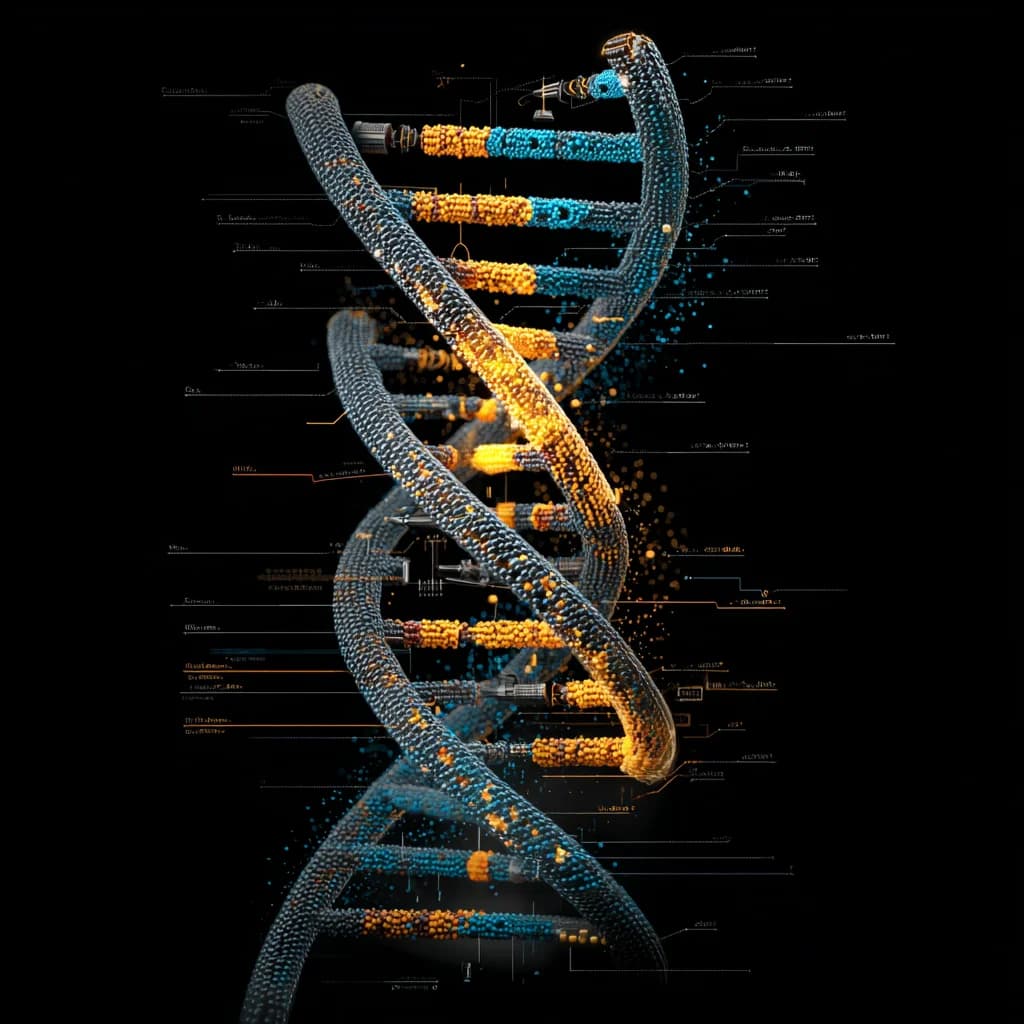
Synthetic biology ends that constraint. We can now read, write, and edit the code of life with increasing precision and speed. CRISPR gave us the editing tool. AI gave us the design intelligence. Together, they make biology programmable on a timeline measured in days, not eons.
The Toolkit
The field has matured from theoretical to industrial in under a decade. DNA synthesis costs have fallen by orders of magnitude, from dollars per base pair to cents, and to fractions of a cent in pooled oligo libraries. Automated foundries can build custom organisms from digital sequence files. AI models like AlphaFold and its successors predict protein structures, design novel enzymes, and optimize metabolic pathways that no human biologist could navigate.
The design-build-test cycle that once took a graduate student's entire PhD now runs in a week.
What Synthetic Biology Builds
The applications are already here and scaling:
Medicine: Engineered cells that hunt tumors. Synthetic gene circuits that detect and respond to disease. mRNA vaccines designed in days. Personalized cell therapies manufactured on demand.
Materials: Spider silk produced by engineered bacteria. Self-healing concrete embedded with organisms. Biodegradable plastics grown in fermentation tanks instead of refined from petroleum.
Energy: Engineered microbes converting waste into fuel. Synthetic photosynthesis more efficient than any plant. Biological systems producing hydrogen from sunlight and water.
Food: Precision fermentation replacing animal agriculture. Crops engineered for drought resistance and nutritional density. Cellular agriculture producing meat without slaughter.
The Bridge to Nanotechnology
Synthetic biology is the practical near-term path to molecular nanotechnology. Biological systems already manipulate matter at the nanoscale with extraordinary precision; every ribosome is a molecular assembler. By learning to design and control biological machinery, we develop the understanding and tools necessary to build non-biological molecular machines.
Eric Drexler's vision of atomically precise manufacturing may arrive through biology first: engineered protein machines that assemble structures with atomic precision, directed by AI, running at biological speed until we can engineer something faster.
The Acceleration
AI transforms synthetic biology from a craft into a science that scales. When an AI system can design a novel organism, predict its behavior, and optimize its function before a single molecule is synthesized, the rate of biological innovation decouples from human intuition. The number of possible biological designs is astronomically larger than what evolution has explored. AI will search that space at a pace biology never could.