Key Points
- •Ray Kurzweil's thesis that the rate of technological change accelerates over time
- •Each new technology builds on previous advances, compounding progress
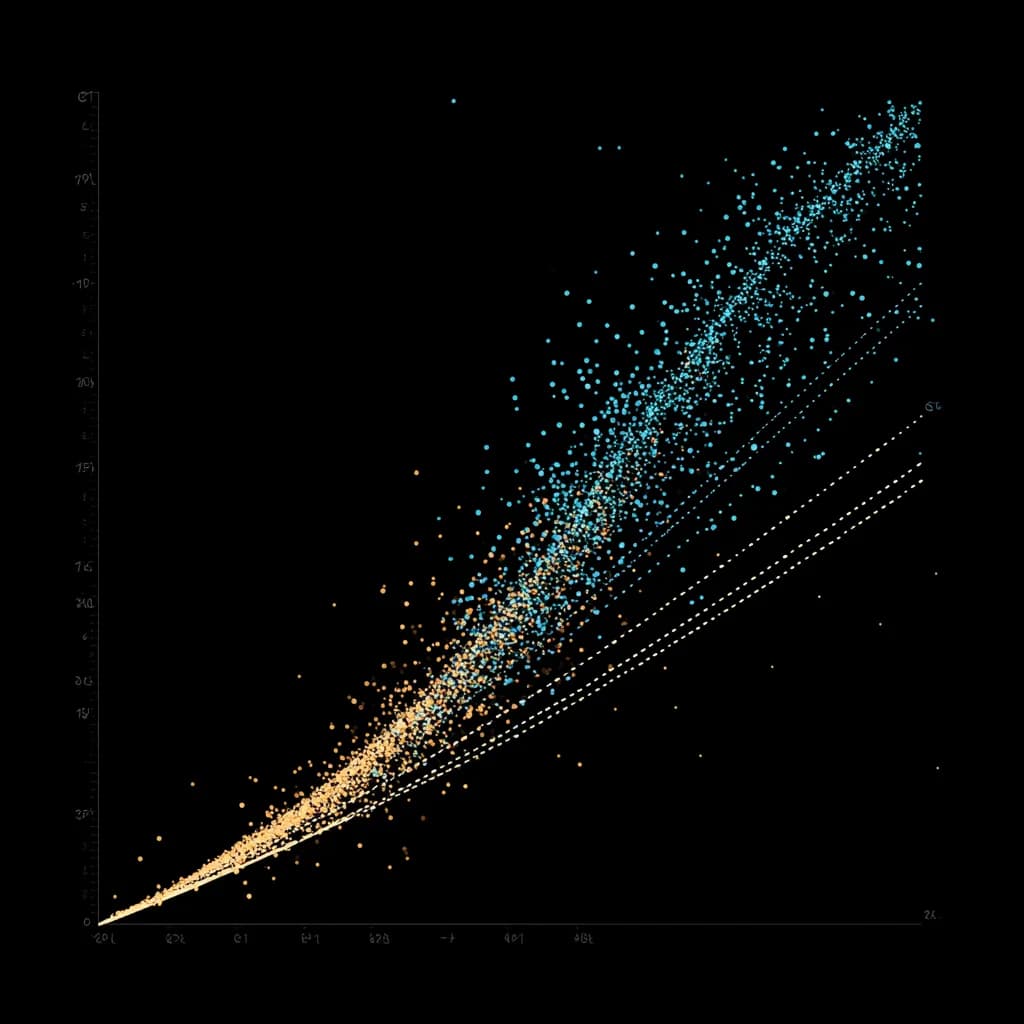
- •Information technologies follow predictable exponential curves
- •Explains why intuitive linear predictions consistently underestimate progress
- •Predicts technological change in the 21st century will be 20,000 years of progress at today's rate
The Core Thesis
Ray Kurzweil's Law of Accelerating Returns states that the rate of change in evolutionary systems, including technology, increases exponentially over time. Each new capability builds on previous capabilities, creating a compounding effect where progress begets more progress.
This is distinct from simple exponential growth. The rate of exponential growth itself increases, creating a double exponential or even faster acceleration.
Why Linear Intuition Fails
Human intuition evolved to understand linear change. If something takes 30 steps to cross a room, we expect the next 30 steps to cover the same distance.
But exponential processes work differently. Thirty linear steps covers 30 meters. Thirty doubling steps, 1, 2, 4, 8, 16..., covers over a billion meters, circling the Earth 26 times.
This is why predictions about technology consistently underestimate progress. In 1990, experts predicted it would take 15 years and $3 billion to sequence the human genome. Skeptics noted that after 7 years, only 1% was complete, suggesting the project would take 700 years. Instead, exponential progress in sequencing technology delivered the complete genome ahead of schedule.
Evidence Across Technologies
Kurzweil documents exponential trends across many domains:
Computing: From mechanical calculators to vacuum tubes to transistors to integrated circuits, computing power per dollar has doubled roughly every two years for over a century, through five different paradigms.
Genome sequencing: Sequencing a human genome cost roughly $100 million in 2001. NHGRI's cost data tracks the fall to around $1,000 by the early 2020s, a decline far steeper than Moore's Law, and newer platforms push lower still.
Solar energy: Cost per watt has declined exponentially for decades, making solar the cheapest source of new electricity in much of the world.
Communication: Bandwidth, storage, and processing for communication have all followed exponential curves.
The 20,000 Years Prediction
Kurzweil calculates that due to acceleration, the 21st century won't experience 100 years of progress at today's rate. Instead, it will experience roughly 20,000 years worth of progress, because the rate itself keeps increasing.
This means the changes we've seen from 2000-2025 are just the beginning. The next 25 years should see more change than the previous 25, and the 25 after that more still.
Implications for the Future
If the Law holds, we should expect:
- AI capabilities to improve faster than most expect
- Biotechnology to transform medicine more rapidly than predicted
- Energy abundance to arrive sooner than conventional forecasts
- Solutions to currently intractable problems to emerge from unexpected directions
The Singularity, in this framework, is simply what happens when exponential curves go vertical on a human timescale, when a year brings more change than a previous decade, and a month brings more than a previous year.