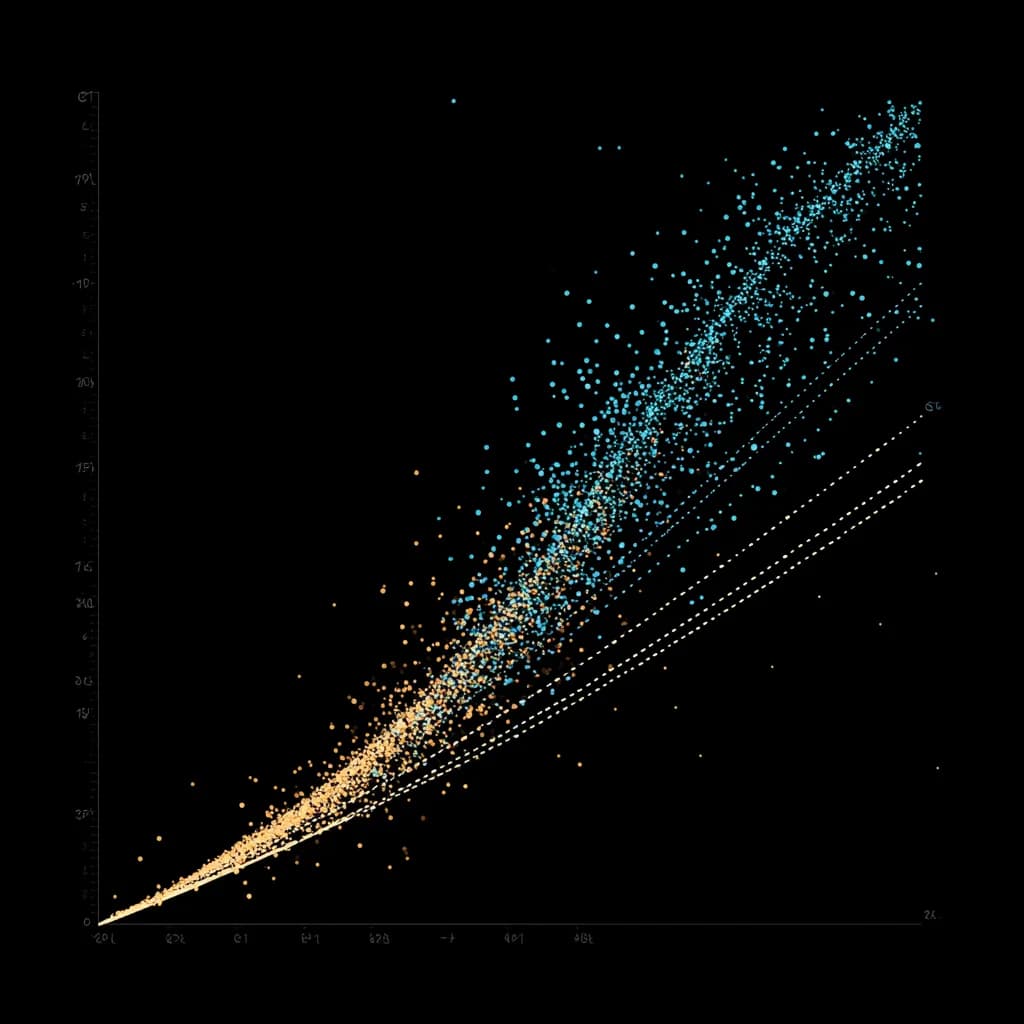
Key Points
- •Models can improve performance by spending more computation at inference, not just during training
- •Chain-of-thought reasoning, tree search, and verification loops let models solve harder problems
- •OpenAI's o1/o3 and Claude's extended thinking demonstrated this as a major new scaling axis
- •Complements traditional pre-training scaling laws rather than replacing them
- •Enables fine-grained compute allocation: simple questions get fast answers, hard ones get deep reasoning
A Second Axis of Scaling
For years, the primary recipe for making AI smarter was straightforward: train bigger models on more data with more compute. This approach, governed by neural scaling laws, drove progress from GPT-2 through GPT-4 and beyond. But in 2024, a second scaling axis emerged that may prove equally important: inference-time compute.
The core idea is simple. Instead of relying solely on a model's trained weights to produce an answer in a single forward pass, you give the model additional computation at the moment of use. Let it reason through a problem step by step. Let it explore multiple solution paths. Let it check its own work. The result is dramatically better performance on tasks that require genuine reasoning, and the improvement scales predictably with the amount of compute applied.
How It Works
Inference-time compute takes several forms, each building on the others:
Chain-of-thought reasoning: The model generates intermediate reasoning steps before arriving at a final answer. The act of producing explicit reasoning steps genuinely improves accuracy on complex problems. Models that "show their work" solve problems that stump models forced to answer immediately.
Tree search and branching: Rather than following a single chain of thought, the model can explore multiple reasoning paths simultaneously, evaluate which branches look most promising, and pursue those further. This resembles how chess engines search through possible moves, but applied to general reasoning.
Verification and self-correction: The model generates a candidate answer, then critiques it, identifies potential errors, and revises. Multiple rounds of this produce substantially more reliable outputs than a single attempt.
Compute-optimal allocation: Not every question needs deep reasoning. Simple factual lookups can be answered in milliseconds, while hard math or logic problems benefit from minutes of deliberation. Inference-time scaling allows the system to allocate compute proportional to difficulty.
The Evidence
OpenAI's o3 made the effect impossible to miss in December 2024. On ARC-AGI-1, a benchmark built to measure fluid reasoning, GPT-4o had scored around 5%. The o3 model scored about 76% at a modest compute budget and about 88% when allowed to think far longer, a gain bought entirely with inference-time computation. The benchmark catalog tracks how reasoning models have pushed further since.
More thinking helps most when a model can explore alternatives and catch its own mistakes, so the value of extra compute rises with the quality of the model's self-checking. Both are improving together.
Why It Matters for AGI
Inference-time compute changes the trajectory toward AGI in several ways.
First, it partially decouples intelligence from training cost. A model that can reason deeply at inference time doesn't need to have memorized every possible reasoning pattern during training. This lowers the barrier to solving novel problems.
Second, it introduces a trade-off between speed and quality that mirrors human cognition. Humans think fast on easy questions and slow on hard ones. Inference-time compute gives AI the same flexibility, with the added advantage that "thinking harder" can scale far beyond human limits: hours or days of serial reasoning on a single problem if needed.
Third, it compounds with pre-training scaling. A bigger model that also thinks longer performs far better than either approach alone. This means the ceiling on AI capability continues to rise even if pre-training scaling alone were to slow down.
AI can now match human reasoning on many hard problems; the live variables are how much compute we are willing to spend per question and how efficiently models use it. Both are improving rapidly.