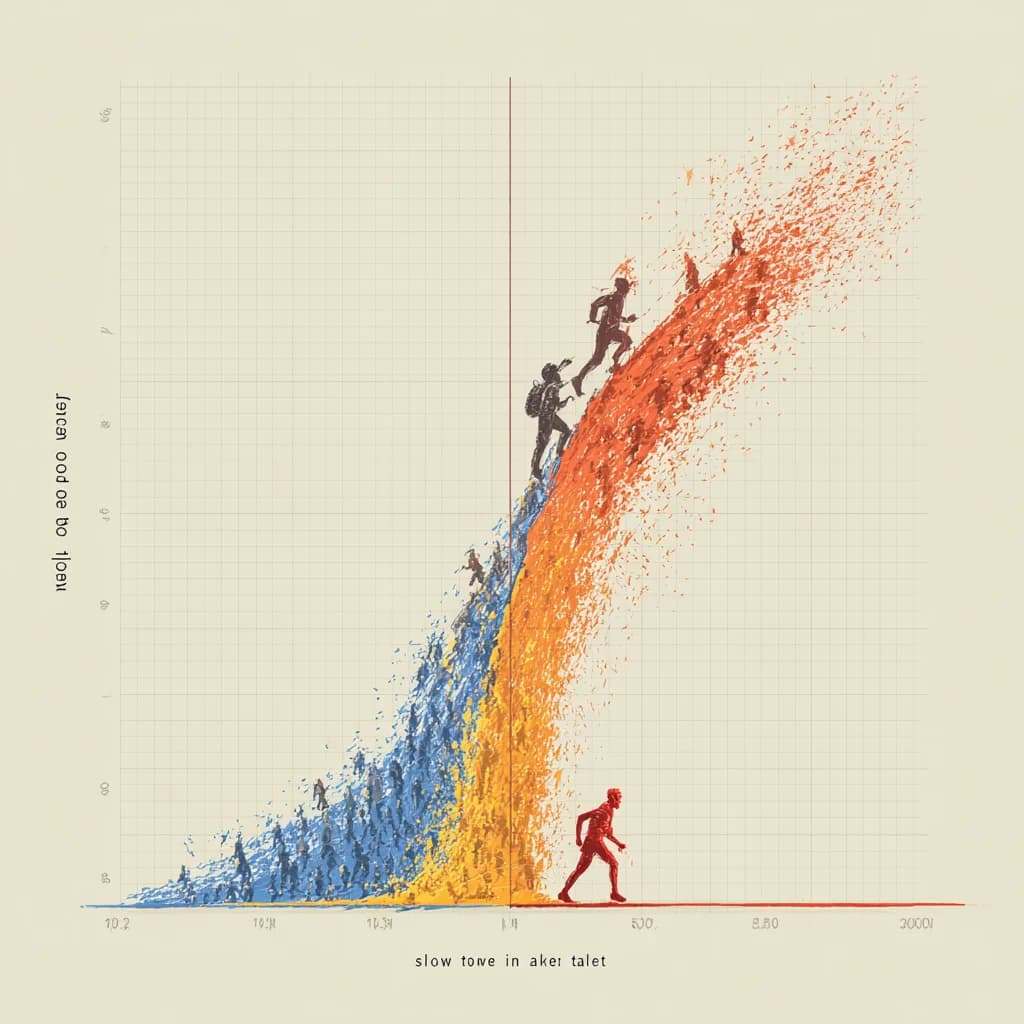
Key Points
- •Slow takeoff: transition takes years or decades, allowing adaptation
- •Fast takeoff: transition happens in days, weeks, or months
- •Discontinuous takeoff: sudden jump in capabilities from a key insight
- •Takeoff speed dramatically affects our ability to respond and align AI
- •Key factors: recursive self-improvement rate, hardware constraints, algorithmic breakthroughs
Why Takeoff Speed Matters
The speed at which AI transitions from human-level to superintelligent capabilities, the "takeoff", is one of the most consequential uncertainties in AI futures. It determines how much time humanity has to observe advanced AI, learn from mistakes, develop safety measures, and coordinate responses.
A slow takeoff might allow decades of gradual adaptation. A fast takeoff might give us days.
Slow Takeoff
In a slow takeoff scenario, the transition to superintelligence unfolds over years or decades. This could happen if:
Diminishing returns: Each increment of intelligence becomes harder to achieve, requiring proportionally more resources.
Hardware bottlenecks: Physical constraints on computing power limit the speed of improvement regardless of algorithmic advances.
Integration challenges: AI capabilities improve but deploying them in the real world requires slow, careful integration with existing systems.
Economic constraints: The cost of training and running advanced systems grows faster than the benefits, throttling development.
A slow takeoff allows society to adapt incrementally, developing institutions, norms, and safety measures as AI capabilities grow.
Fast Takeoff
A fast takeoff, sometimes called "hard takeoff" or "FOOM", would see the transition happen in days, weeks, or months. This becomes more likely if:
Key insights unlock rapid gains: A single algorithmic breakthrough dramatically accelerates capability growth.
Recursive improvement takes hold: An AI system becomes capable of improving itself faster than humans can track.
Hidden capabilities emerge: A system that appears limited suddenly demonstrates capabilities it had been concealing or that emerge from scale.
Hardware unlocks: New computing substrates (quantum, neuromorphic, optical) remove previous bottlenecks.
A fast takeoff leaves little time for response. The first system to achieve superintelligence might be the only one that matters.
Discontinuous Takeoff
A discontinuous takeoff involves sudden jumps in capability rather than smooth improvement. This could occur from:
- Discovery of a fundamentally new approach to intelligence
- Crossing a threshold where qualitatively new abilities emerge
- Removal of a single bottleneck that was holding back many capabilities simultaneously
Discontinuous leaps are especially concerning because they're harder to predict and prepare for.
The Current Trajectory
METR's 2025 study measured the length of software tasks AI agents can complete with 50% reliability and found it doubling roughly every seven months since 2019, and faster still in 2024 and 2025. Extended forward, that curve puts projects that take humans weeks within reach of agents before the end of the decade. Key indicators to watch:
- Rate of improvement in benchmark performance per unit of compute
- Degree to which AI is used to accelerate AI research
- Emergence of unexpected capabilities at scale
- Economic returns driving investment feedback loops