Key Points
- •AI systems that autonomously design experiments, analyze results, and generate novel hypotheses
- •AlphaFold predicted structures for nearly every known protein and won the 2024 Nobel Prize in Chemistry
- •AI-driven labs run thousands of experiments per day with minimal human oversight
- •Closes the loop between hypothesis, experiment, and analysis, with experimental validation keeping results grounded
- •May be the single highest-leverage application of superintelligence
The Recursive Engine
Science advances when we can ask more useful questions and test them faster. AI is beginning to expand both sides of that equation: searching enormous datasets for overlooked patterns, proposing experiments, and helping researchers interpret the results. The opportunity is a larger capacity for discovery, well beyond a faster research assistant.
What Already Works
The AlphaFold database holds predicted structures for over 200 million proteins, nearly every protein known to science, work that earned its creators the 2024 Nobel Prize in Chemistry. GNoME reported 2.2 million new crystal structures, including about 380,000 predicted to be stable, many times the number of stable materials humanity had previously identified, and external labs have already synthesized hundreds of them.
Predictions still have to survive the lab, which is exactly why the next step matters.
The Closed Loop
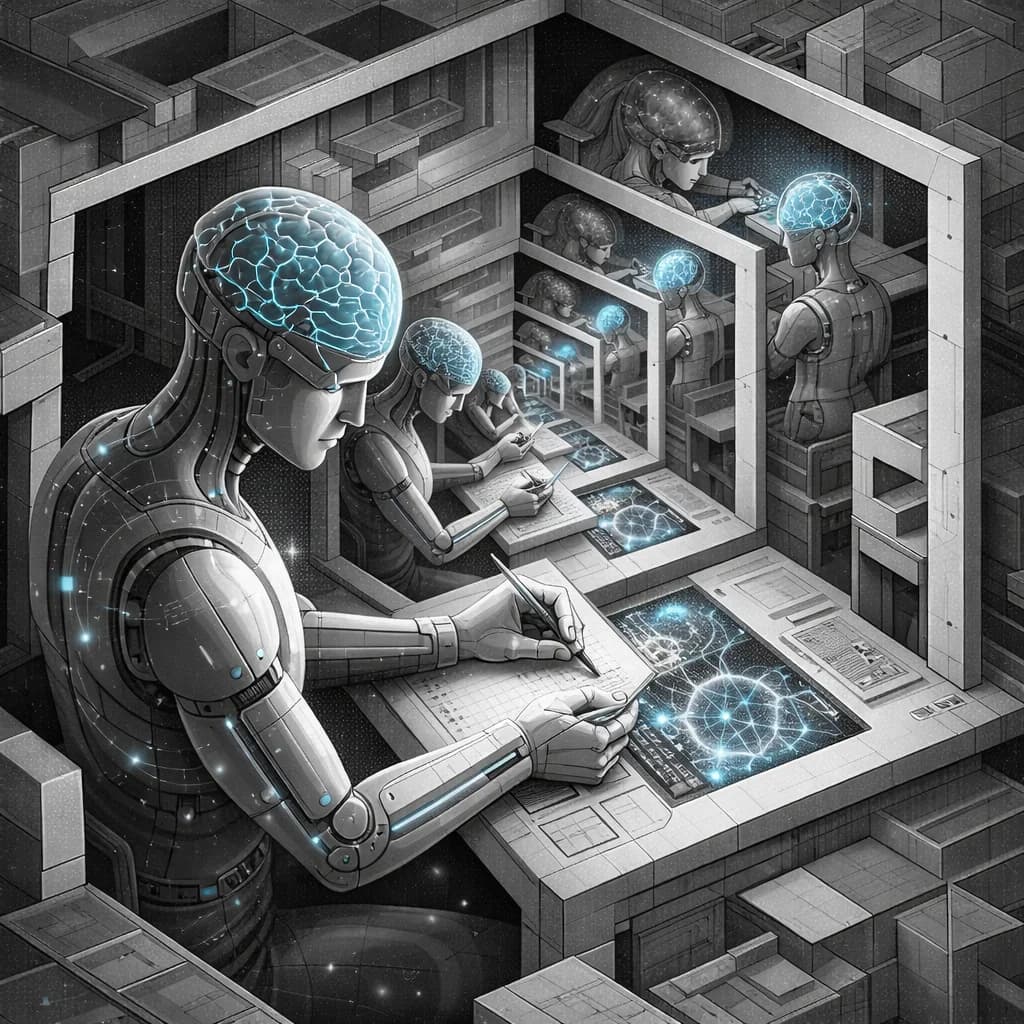
The next step is closing the loop: AI systems that formulate hypotheses, design and run physical experiments through robotic labs, interpret results, and iterate. Several labs have demonstrated this cycle already. Emerald Cloud Lab and similar platforms let AI agents operate wet lab equipment remotely. The human role shifts from doing the science to deciding which questions to ask.
When the AI is also generating the questions, the loop closes completely. At that point, scientific progress decouples from human cognitive bandwidth.
Why This Accelerates Everything
Automated science is the meta-application of AI, the one that accelerates all others. Better materials science means better chips, which means faster AI, which means better science. Better drug discovery means longer healthy lives for the researchers building the next generation of AI. Better energy research means cheaper compute.
This is recursive self-improvement expressed through the physical world. The intelligence explosion can proceed this way too, through an AI that designs better experiments, discovers better algorithms, and engineers better hardware, each cycle faster than the last, with no single system rewriting its own source code.
Discovery and Validation
Automated science must connect a promising computational result to evidence about the world. AI-led searches through genomic data illustrate one route: software identifies an overlooked pattern, then researchers investigate its function through experiments. Finding a candidate, explaining it, and establishing a useful application are distinct stages of discovery.
AI can also improve the tools used to evaluate hypotheses. Algorithm optimization for scientific analysis illustrates this second route. Better instruments of analysis can make future experiments more informative, creating a feedback loop between discovery and the means of discovery.